Jump to a question in this guide
- What does a roof noise actually tell us?
- When should people keep clear and get urgent help?
- Why does the species matter before an opening is closed?
- How can a small roof junction become an access question?
- Why can sealing first trap the problem inside?
- What changes when there may be young or a protected nest?
- Why must the repair preserve roof and ventilation functions?
- What should stay undisturbed inside the attic?
- Does possible chewing or a ceiling mark prove hidden damage?
- What should a wildlife proposal explain?
- How do shared buildings, neighbours and local authorities change coordination?
- What does follow-up establish after exclusion and repair?
- How would a fictional household turn a roof sound into a scoped plan?
- What should the handover make easy to understand?
- A sound, sighting and opening are different evidence.
- Occupancy and dependent young matter before closure.
- Species and current local requirements govern authorized work.
- Exclusion, building repair and affected-system assessment need separate records.
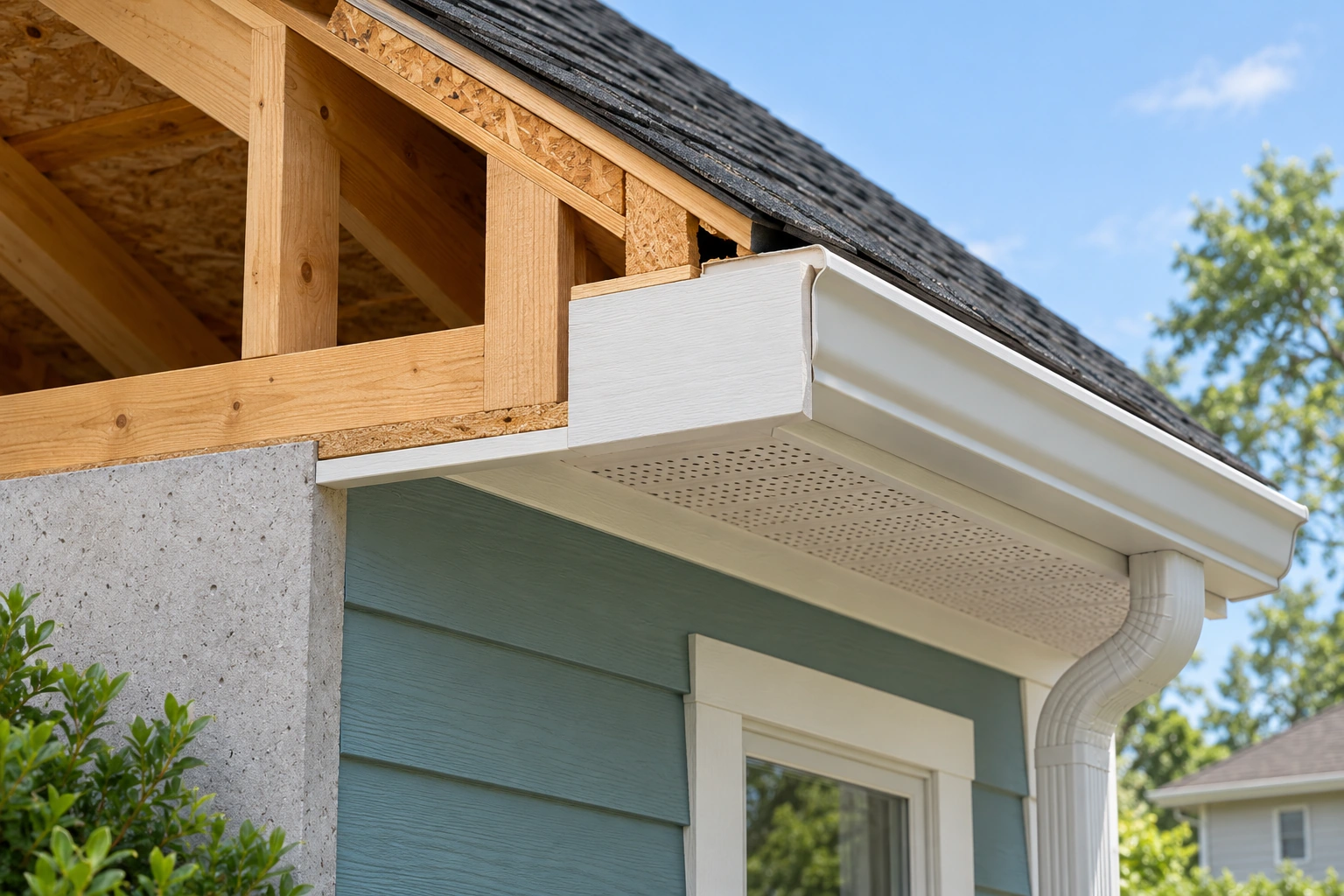
The skeletal roof edge separates covering, fascia, soffit and gutter around a conceptual junction. No animal is drawn; the opening helps locate a provider question rather than tracing an occupied route.
About this illustration
Conceptual model, no actual opening continuation, species, occupancy, roof defect or repair design. This is a conceptual teaching model, not an assessment of your home.
7 picture lessons appear beside the questions in this guide. Use them to understand the explanation, then consider what it means for your home.
What does a roof noise actually tell us?
A sound tells you where and when it was heard. It does not independently identify an animal, prove that the animal entered the attic or show its route through the building. A visible opening, a reported sighting and an unfamiliar material are other pieces of evidence with their own limits. Begin by keeping those observations distinct before deciding which wildlife and building questions need assessment.
A useful first account names the room or ground-level viewpoint, approximate time, known recurrence and any safely observed outside activity. Attribute another person’s report. If the time or exact location is uncertain, say so. A clear limited account is more useful than a confident description of a species in a concealed space that nobody has actually identified.
The roof-edge cutaway shows a junction among roof covering, fascia, soffit and gutter. One conceptual opening helps explain why a provider asks about building interfaces. It shows no animal, occupied route or species-specific gap. The native evidence figure then separates observation, identification, route and authorized next work rather than drawing an imaginary journey through the actual house.
This guide owns wildlife access to roofs and attic spaces, authorized exclusion and compatible opening repair. The rodent guide owns its broader entry, food, storage and contamination enquiry. The roof guide owns heat, rain, air and assembly evidence. A wildlife concern can connect those jobs without turning one scratching sound into a roof, electrical or public-health diagnosis.
Follow the boundaries separately. An animal outside the roof, an animal using an opening, an occupied roof space and an animal in a living room are different situations. A roof-space observation does not automatically describe contact with occupants, while a living-space event may require a different urgent response. Ask the professional to connect the actual evidence across each boundary it assesses. This gives the household a concrete map of what is known, rather than assuming that one outside sighting explains everything above the ceiling.
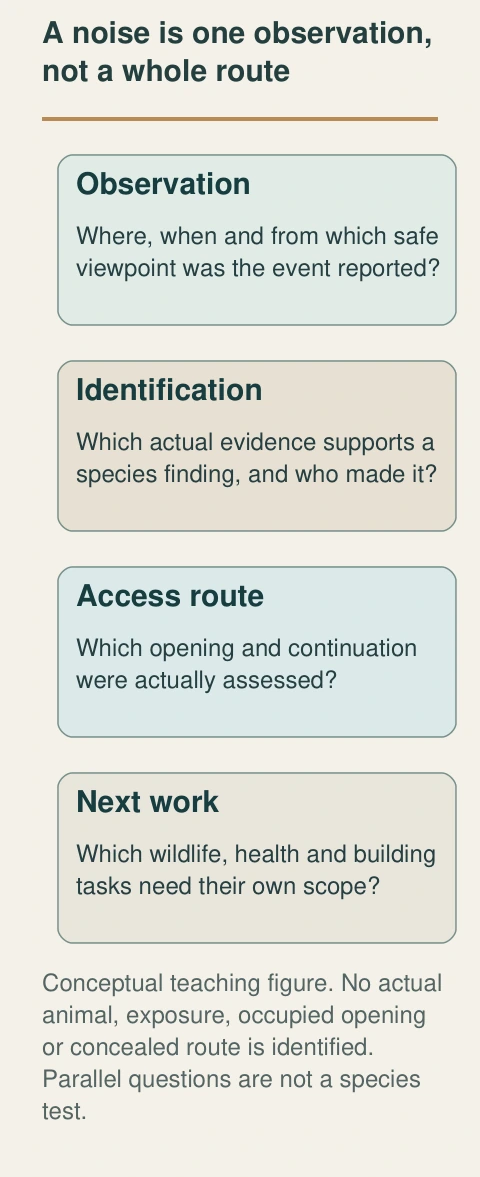
A noise is one observation, not a whole route
A roof sound starts an observation record. The figure connects its time and location to the separate species, assessed-opening and next-work questions; no arrow substitutes for a professional finding.
Numbers identify the parts explained below.
What does this illustration leave out?
No actual animal, exposure, occupied opening or concealed route is identified. Parallel questions are not a species test. This illustration explains an idea. It is not an installation guide.
What connects the observation to the provider’s actual finding?
Explore this with HomeAI ↗Opens an editable question. Nothing is sent until you choose to send it.Four records with different meanings
- SoundWhere and when heard; no independent species.
- SightingWhat was observed from safe access.
- OpeningA visible junction; continuation and purpose can remain unknown.
- Qualified findingSupported identity, route and occupancy within scope.
No actual animal or route identified.
Further reading: Alberta · Human-wildlife conflict: Bats; Alberta · Human-wildlife conflict: Red squirrels.
Read the complete figure
A noise is one observation, not a whole route
Original native teaching figure: A noise is one observation, not a whole route. The complete labelled relationships distinguish the functions below; they describe conceptual questions rather than an actual property finding.
- Observation
- Where, when and from which safe viewpoint was the event reported?
- Identification
- Which actual evidence supports a species finding, and who made it?
- Access route
- Which opening and continuation were actually assessed?
- Next work
- Which wildlife, health and building tasks need their own scope?
What remains unknown: No actual animal, exposure, occupied opening or concealed route is identified. Parallel questions are not a species test.
A useful question: What connects the observation to the provider’s actual finding?
When should people keep clear and get urgent help?
Keep children, pets and other people away from an unfamiliar animal or suspected occupied location. Do not handle, chase, capture or release an animal to identify it. If contact, a bite or scratch may have occurred, obtain prompt medical and local public-health advice. PHAC explains that very small bat bites or scratches can be difficult to notice; a remote article cannot clear an individual exposure.
Tell the healthcare professional what is known about the event and the animal’s location, preserving uncertainty. Do not create further contact to improve the account. The appropriate health and wildlife responders determine what information, testing or handling is needed. This guide supplies no vaccination decision, exposure score, wound-treatment sequence or permission to let a potentially relevant animal leave.
Electrical smoke, sparks, burning smells, damaged wiring or an unstable ceiling require their own immediate response. Leave the affected area and use emergency services when danger is present. A wildlife appointment is not a substitute for fire, electrical or structural help. Do not enter an attic to see whether an animal has damaged a cable or caused the symptom.
For a non-emergency concern, ask the local wildlife authority or suitable professional which response fits the identified animal and setting. Alberta explains limits to wildlife-officer attendance and directs different concerns through relevant contacts. Another region may have different arrangements. A public contact route is not a promise that an officer will inspect every roof or that a private service is authorized for every species.
Human health and animal identification can proceed as coordinated but separate enquiries. A healthcare professional can advise about the person’s reported contact while wildlife responders determine appropriate handling or identification. Waiting for a convenient roof appointment should not delay advice about possible exposure. Equally, a photograph identifying a species cannot establish whether a particular person was exposed. Keep the event details accurate and available to the responsible professional, without approaching the animal or sharing private health information with everyone involved in the building work.
Why does the species matter before an opening is closed?
Species differ in how they use buildings and in the protections or welfare questions that apply. Alberta’s bat page describes use of existing openings and building roosts. Its red-squirrel page describes possible enlargement of openings and building damage. These examples explain why identification matters; they do not let a homeowner identify the animal from a roof noise, hole photograph or time of day alone.
Ask the provider what evidence supports the identification, where it was obtained and whether the finding is tentative. The appropriate response may need a wildlife specialist, local authority or another qualified role. A provider should explain the actual species and scope it can address rather than treating every attic concern as an interchangeable pest-removal job.
A schedule is only a clue. A sound at night or daytime outside activity does not establish a species, number of animals or whether young are present. Keep timing in the record without promoting it into an identification key. A safely observed animal outside may also be unrelated to the sound inside unless suitable evidence connects them.
Do not set bait, traps or cameras in inaccessible spaces, produce noise to flush animals or approach a suspected nest to resolve uncertainty. The provider chooses suitable assessment within current legal and safety limits. The guide’s species examples support questions about the actual plan, not owner experimentation or a nationwide claim about which wildlife occupies Canadian roofs.
The animal’s use of the space matters alongside its name. Resting, nesting, moving through a route and foraging near the building describe different relationships. A provider should explain which of those it actually established and what remains uncertain. This can change the welfare, timing and building questions even for the same identified species. General knowledge that an animal sometimes uses attics is not proof that it is nesting in this attic, and a single animal observed outside cannot determine whether other occupants remain within the relevant space.
How can a small roof junction become an access question?
A roof edge is made of connected parts. Covering manages weather on the upper surface; the fascia closes the edge; the soffit sits beneath an overhang; gutters collect water into their intended route. Service openings and vents add other interfaces. A visible gap at one junction raises an access question while leaving its continuation, original purpose and occupancy unknown.
The close roof picture makes those familiar parts easier to name in a service request. It does not assign a species to the gap or establish that it leads into the attic. A provider should explain what connects the exterior observation with the supported inside finding. Some areas may require professional access or remain unassessed under the initial visit.
An opening can also perform a necessary building or equipment function. A vent, exhaust termination or drainage detail should not be blocked simply because it appears accessible to an animal. Have the appropriate wildlife and building providers determine a compatible response. This guide specifies no screen, mesh size, sealant, vent replacement or universal hole dimension.
Keep the location precise enough for the repair record. Rear eave beside the downspout is more useful than roof hole if several interfaces exist. Use existing photographs and safe ground views without climbing or approaching utility lines. The inspection and work plan should state which junction was examined, what it actually connects to and which neighbouring interfaces remain outside the scope.
Several visible junctions can create a mapping problem. One may be a confirmed route, another a designed vent and another an unassessed gap. Label them by familiar location in the service account rather than treating all three as equivalent holes to fill. The provider’s proposed work should explain the reason for each included location. That makes a later photograph or invoice reviewable: the next person can see which opening was assessed, why its treatment differed and whether another location still requires an answer.
A roof junction raises an access question
The skeletal roof edge separates covering, fascia, soffit and gutter around a conceptual junction. No animal is drawn; the opening helps locate a provider question rather than tracing an occupied route.
Numbers identify the parts explained below.
What does this illustration leave out?
Conceptual model, no actual opening continuation, species, occupancy, roof defect or repair design. This illustration explains an idea. It is not an installation guide.
What connects the visible junction with the actual wildlife finding?
Explore this with HomeAI ↗Opens an editable question. Nothing is sent until you choose to send it.Why can sealing first trap the problem inside?
Exclusion means preventing future access through an appropriate plan. Closing a route while animals or dependent young remain can confine them inside or separate them from necessary care. Alberta’s bat and squirrel guidance both explain why occupancy matters before final closure. A repair that looks neat from outside can therefore be the wrong first action when the actual wildlife status is unresolved.
Ask who will establish whether the route is occupied, what the actual plan requires and how the relevant stages are documented. The answer needs to fit the identified species, season, local rules and building. This guide does not supply a one-way device, closure sequence or assurance that an evening without visible activity establishes vacancy.
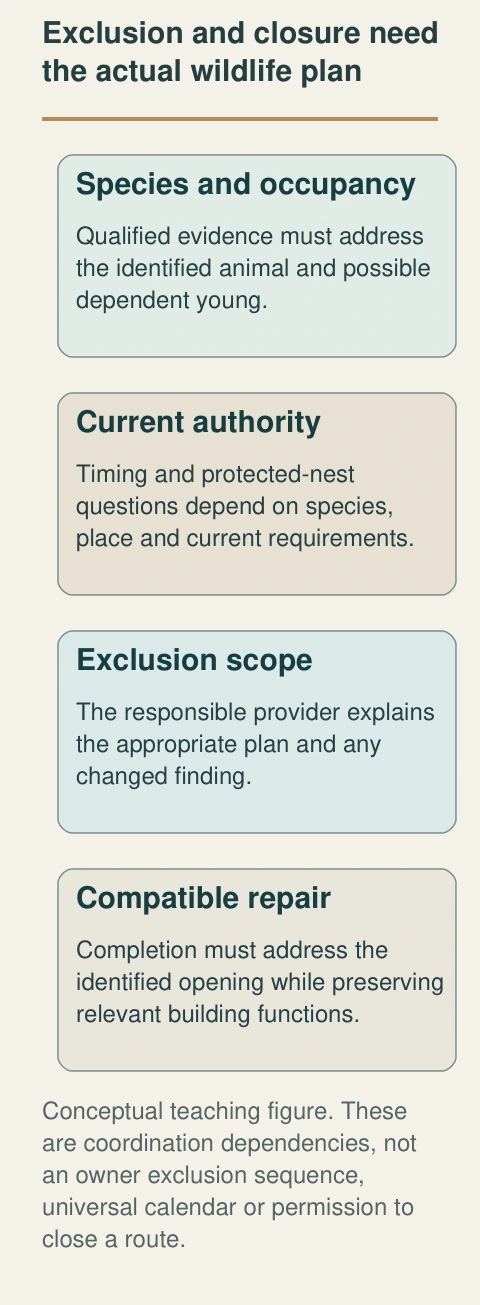
The native exclusion figure distinguishes identification and occupancy, appropriate timing/authorization, the qualified exclusion scope and subsequent compatible repair. Its stages explain responsibilities rather than an owner method. A professional may need to adapt the plan when conditions change. Preserve that explanation instead of treating the original booking date as proof that every later step is permitted.
If the household cannot wait because a health or safety issue exists, obtain the appropriate urgent authority and professional advice. Alberta’s bat page specifically directs such conflicts to Fish and Wildlife rather than an improvised removal. The route elsewhere must be confirmed locally. Urgency changes whom to contact; it does not authorize sealing an unknown occupied space or handling the animal.
The absence of visible adult activity is not the same evidence as a supported vacancy finding. Activity may not be observed from the available viewpoint or during the relevant period, and dependent young may not appear at the opening. Ask what basis the professional uses for the actual plan and what conditions require it to stop or change. An owner’s ordinary quiet-evening observation can remain useful history without being promoted into permission for final closure. The sequence should be justified by the provider rather than by the household’s wish to finish quickly.
Exclusion and closure need the actual wildlife plan
A closure plan depends on the actual species, occupancy and possible dependent young. The figure keeps those findings and current authority ahead of provider-defined exclusion and a repair that preserves building functions.
Numbers identify the parts explained below.
What does this illustration leave out?
These are coordination dependencies, not an owner exclusion sequence, universal calendar or permission to close a route. This illustration explains an idea. It is not an installation guide.
Who establishes each finding before the related work proceeds?
Explore this with HomeAI ↗Opens an editable question. Nothing is sent until you choose to send it.Understand the authorized stages
- Identify and assessSpecies, occupancy and limits.
- Resolve timing and authorizationCurrent requirements and actual situation.
- Perform the qualified scopeDocument what was actually done.
- Repair compatiblyPreserve building functions and retain follow-up.
No exclusion device, sequence to perform or legal clearance.
Further reading: Alberta · Human-wildlife conflict: Bats; Environment and Climate Change Canada · Guidelines to avoid harm to migratory birds.
Read the complete figure
Exclusion and closure need the actual wildlife plan
Original native teaching figure: Exclusion and closure need the actual wildlife plan. The complete labelled relationships distinguish the functions below; they describe conceptual questions rather than an actual property finding.
- Species and occupancy
- Qualified evidence must address the identified animal and possible dependent young.
- Current authority
- Timing and protected-nest questions depend on species, place and current requirements.
- Exclusion scope
- The responsible provider explains the appropriate plan and any changed finding.
- Compatible repair
- Completion must address the identified opening while preserving relevant building functions.
What remains unknown: These are coordination dependencies, not an owner exclusion sequence, universal calendar or permission to close a route.
A useful question: Who establishes each finding before the related work proceeds?
What changes when there may be young or a protected nest?
Dependent young can remain when an adult is temporarily elsewhere. An outside observation of departure does not establish that a roost or nest is empty. The professional assessment and current species-specific requirements must address that possibility. A generic seasonal chart cannot decide the status of a particular roof opening or authorize work at an address.
ECCC’s overview explains that migratory bird protections differ with occupancy and species, including some nests protected when unoccupied. It also says other federal, provincial or territorial protections may apply. The practical lesson is to avoid disturbing a suspected nest and obtain suitable current advice before the proposed work. This article gives no legal removal permission or calendar of safe dates.
For bats, Alberta’s provincial page discusses endangered species and dependent-young timing. Those details belong to that jurisdiction and its actual source; they should not be copied into a national exclusion schedule. Ask the relevant wildlife authority and qualified provider which current requirements and evidence govern the named species and situation.
Record the advice and its scope alongside the project. A roofer’s availability and a wildlife provider’s proposed date are planning facts, while authorization and occupancy findings answer different questions. If the species remains uncertain, preserve that uncertainty and the task to resolve it. Do not approach, illuminate or disturb a nest to make the file more complete.
A general nesting calendar is a planning aid, not an inspection result. ECCC’s overview explains that species and site conditions affect the relevant protection questions and that some nests have a different year-round status. The guide therefore does not announce a season when all roof work is allowed. Have the responsible qualified people identify the current requirements for the actual work and retain their advice. If the available evidence does not establish nest status, the uncertainty should remain a constraint to resolve, rather than disappear because the contractor has an open date.
Why must the repair preserve roof and ventilation functions?
A wildlife opening and the surrounding assembly have different jobs to consider. The proposed repair should prevent the identified access while preserving the actual roof’s water, air and equipment functions. A barrier across a designed vent can change the building question rather than simply improve wildlife control. The right scope should explain those interfaces in the actual roof.
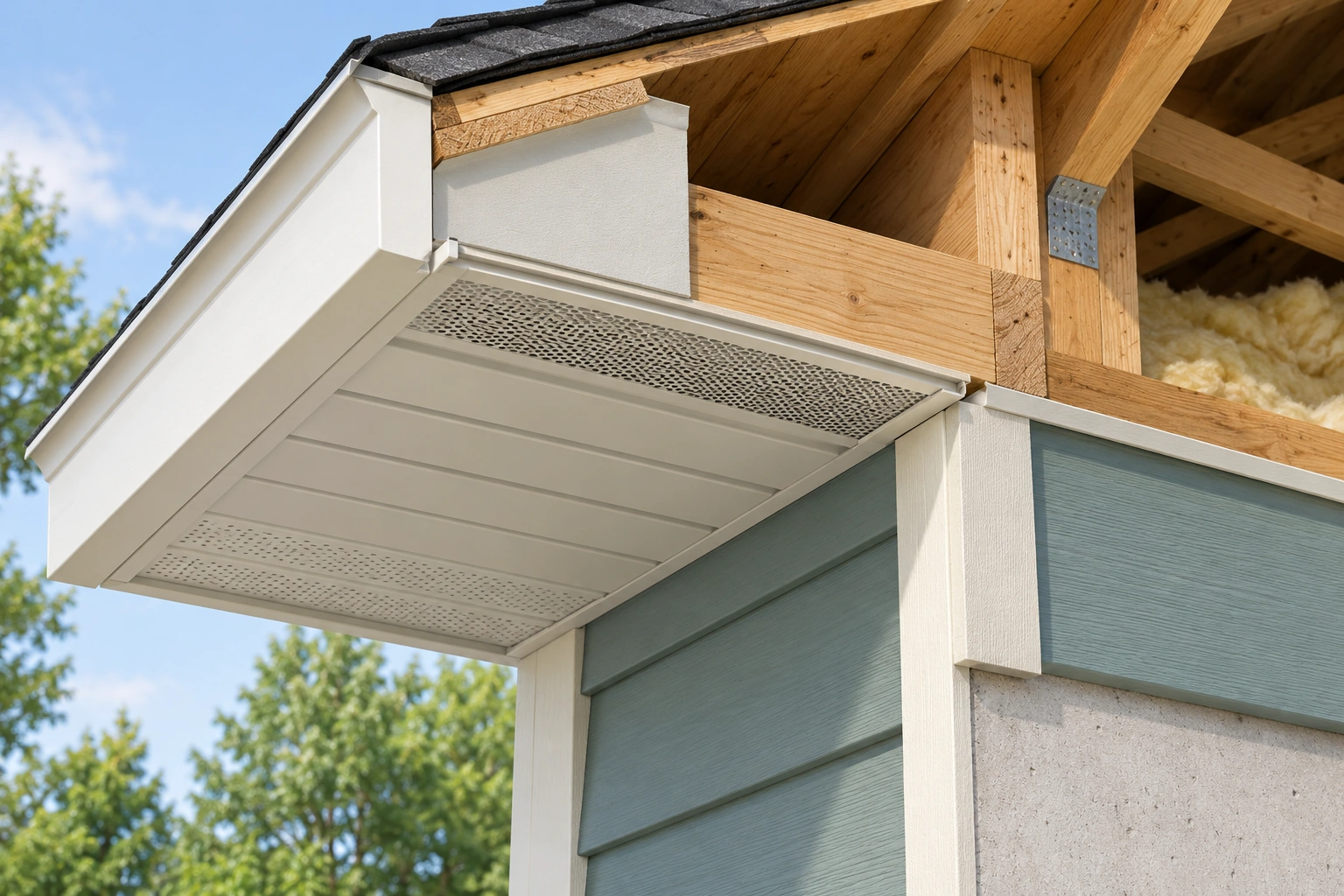
The vent close-up shows an intact opening beside the eave structure. Its role is to remind the reader that an opening can be intentional. The image gives no vent area, airflow result, mesh specification or approved repair detail. Ask the building specialist what should remain functional and which manufacturer or project information governs the proposed alteration.
A gutter, flashing or exhaust termination may need a different trade from wildlife identification. The providers should say who addresses each task and how they coordinate access and completion. A wildlife invoice should not silently stand in for roofing work, and a roof patch should not become proof that the wildlife question was resolved.
Retain photographs of the actual completed interface when the responsible professional can safely provide them. Keep the work location and relevant explanation with the image. A clean surface shows appearance; it does not independently establish ventilation performance, waterproof continuity or the absence of other access routes. The record should identify the supported finding and the remaining building question.
The repair boundary can be wider or narrower than the original wildlife assessment. Replacing an edge component may expose another building issue, while an exterior patch may leave concealed insulation untouched. Ask how new findings are communicated and which provider decides whether the scope must expand. A broader building project may also change the planned wildlife access or timing. Coordinating those interfaces before work helps avoid a repaired-looking junction hiding a still-open question about the actual assembly, without prescribing a universal construction sequence.
An intentional opening still has a building job
The soffit close-up shows a perforated vent area beneath intact roof-edge parts and exposed teaching-model timber. It makes the intentional opening distinct from an assumed wildlife entry point.
Numbers identify the parts explained below.
What does this illustration leave out?
No vent area, airflow, species gap, mesh specification or approved animal barrier is established. This illustration explains an idea. It is not an installation guide.
Which intentional function must the actual repair preserve?
Explore this with HomeAI ↗Opens an editable question. Nothing is sent until you choose to send it.What should stay undisturbed inside the attic?
An attic can contain insulation, wiring, framing, equipment and unfamiliar material. A wildlife concern can introduce additional access and contamination questions, but appearance alone does not identify what a patch contains. Do not enter, move insulation, handle suspected waste or open a cavity to improve a household record. Arrange suitable professional access and assessment.
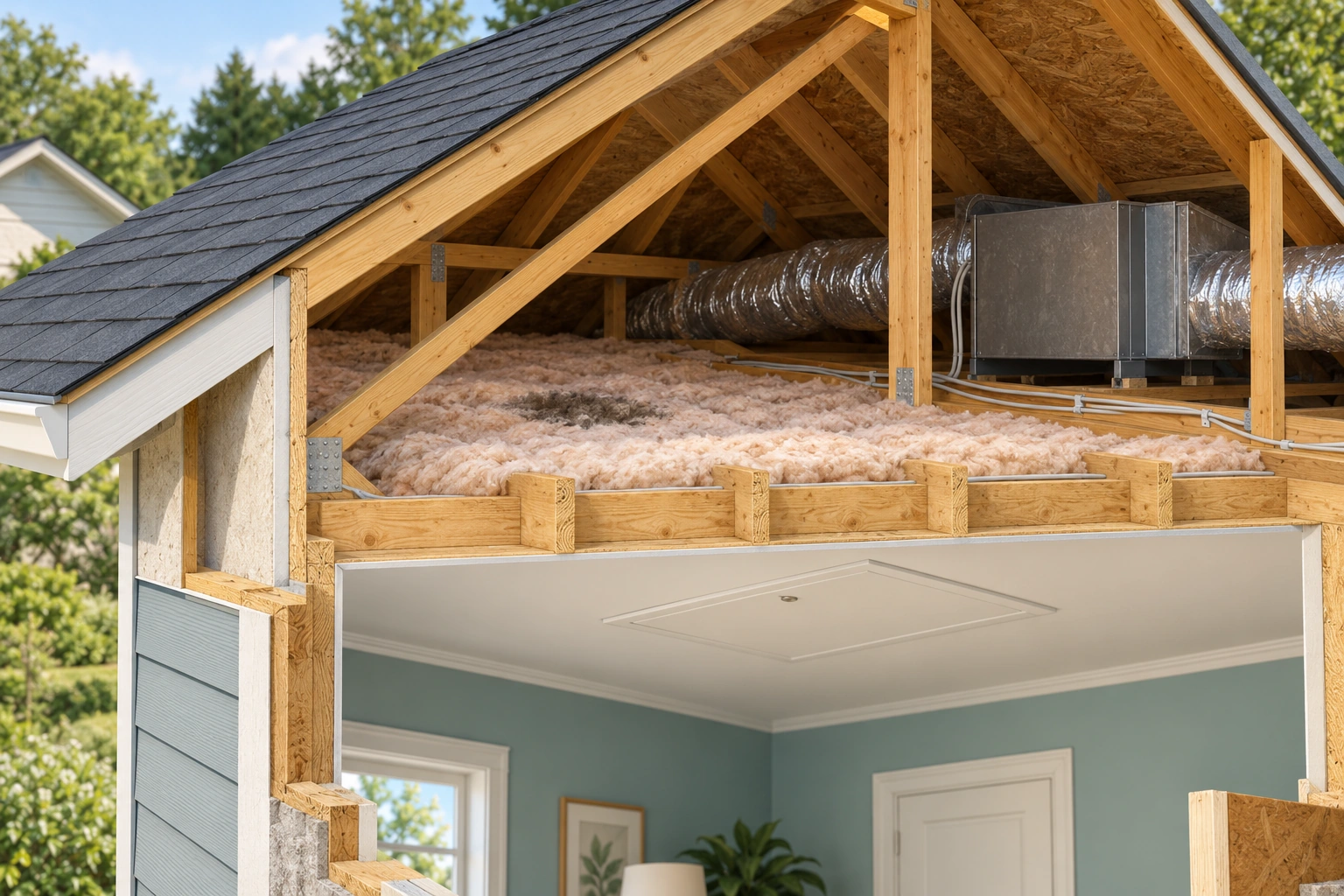
The attic cutaway is viewed from outside the conceptual model. Its closed hatch, insulation and intact closed routes explain why an inaccessible area can involve several systems. The indistinct patch is deliberately unknown. It is no actual waste, nest or mould specimen and supplies no cleanup technique, protective-equipment selection or safe-entry clearance.
Ask the provider which materials and areas were assessed, what evidence supports any finding and who handles the appropriate cleanup or restoration scope. Exclusion work can address access without cleaning affected material. Cleaning can address a defined area without establishing every electrical or structural condition. Keep those deliverables separate even when one company coordinates several services.
The older Alberta bat page includes handling and guano-cleaning suggestions that are not adopted here as a new owner method. The actual contamination, materials, access and applicable guidance require qualified advice. No sweeping, vacuuming, bleach mixture or mask-as-clearance instruction is supplied. An unknown material should remain undisturbed while the correct assessment and next work are arranged.
Older insulation and finishes can introduce a material question independent of wildlife. Health Canada advises avoiding disturbance of potentially asbestos-containing material and obtaining professional assessment before relevant renovation work. The home’s age or an insulation photograph cannot establish a material finding. If access or repair would disturb an unfamiliar layer, have that issue incorporated into the qualified plan before work. A wildlife provider’s confirmation of an animal does not identify the insulation, and a material report from another room does not automatically cover the attic area.
An attic concern includes more than wildlife
Viewed outside the teaching model, the attic contains insulation, framing and intact ductwork above a closed ceiling hatch. The room below and concealed space are different access and assessment boundaries.
Numbers identify the parts explained below.
What does this illustration leave out?
No animal waste, asbestos, identified contamination, actual duct route or permitted owner entry is shown. This illustration explains an idea. It is not an installation guide.
Who assesses the actual space and unfamiliar material without household disturbance?
Explore this with HomeAI ↗Opens an editable question. Nothing is sent until you choose to send it.Does possible chewing or a ceiling mark prove hidden damage?
Alberta’s squirrel page describes possible insulation and wiring damage. That establishes a reason to ask about affected systems when the identified activity and conditions warrant it. It does not establish that a particular animal damaged this house or that every cable near a reported sound is unsafe. A supported finding needs the appropriate inspection and professional scope.
An electrical professional addresses the relevant wiring concern, while a building or structural specialist addresses its own material or support question. A wildlife provider may identify signs prompting those referrals without certifying the other systems. Ask which areas were actually assessed and what remains concealed or inaccessible. A general service description should not become a whole-attic clearance.
Ceiling stains or dampness may also have other routes, including roof water or indoor-moisture conditions. The roof and moisture guides explain those distinct mechanisms. Record timing, location and the source of the account, without assigning the stain to wildlife because both concerns involve the attic. The provider should explain what evidence connects them, if any.
Do not energize, expose or manipulate suspect equipment, pull insulation aside or reproduce a noise to decide between causes. Immediate electrical or structural hazards take priority. For a non-emergency unresolved condition, request a defined follow-up scope and retain its findings beside the wildlife history. Missing access is an explicit uncertainty, not proof of either damage or normal condition.
What should a wildlife proposal explain?
A clear proposal names the supported concern, species or identification task, relevant locations, assessment limits and planned stages. Ask who confirms the current legal and welfare requirements for the actual situation. The document should distinguish investigation, exclusion, compatible building repair, contamination work and follow-up. The phrase animal removal is too broad to explain those separate responsibilities.
Ask what changes if another occupied route, nest or material concern is found. The provider should explain how the plan and authorization are revisited and who informs the household. A fixed price can still have a limited scope, while a broad promise may exclude difficult access. Compare the actual deliverables and exclusions before treating two proposals as equivalent.
Have the building repair described by its interface and purpose. Which eave, vent or other component is involved? Which functions must remain? Which appropriate provider performs the work and supplies its completion record? This is a coordination request, not a design for mesh, traps, sealants, pruning or roof access.
Do not assume that a provider’s general pest experience establishes authority for every protected species, contaminated space or electrical repair. Confirm the relevant qualifications and local arrangements for the assigned work. A suitable specialist should be able to explain its boundary and refer the remaining question. This article supplies no universal wildlife licence, approved contractor list, price or eradication guarantee.
The proposal should also distinguish the work area from the observation area. A provider may observe an exterior interface from a safe position while needing different equipment or authorization to perform its repair. Ask what access the work requires and what other household or shared-building functions it affects. Those practical constraints belong in the agreed scope. They should not be left for the homeowner to improvise with a ladder, electrical extension or temporary opening because the assessment photograph made the junction look easy to reach.
How do shared buildings, neighbours and local authorities change coordination?
A roof or attic can be shared even when the reported sound is inside one unit. Access, enclosure work, affected materials and communication may involve the owner, manager or another responsible party. Tell the relevant contact what was actually observed and ask who coordinates the assessment. Do not alter a common opening or arrange work in another unit from a private household assumption.
Trees, utility lines and neighbouring structures can also appear in the account without establishing an animal’s route. Ask which relationship is supported and which task needs the appropriate owner or utility. The tree guide explains those separate site and authority questions. Never modify a utility line or prune near it to interrupt a suspected wildlife path.
Local response pathways differ. A municipal service, provincial wildlife office, rehabilitation organization and private wildlife provider may perform different roles. Ask the relevant authority which route applies to the actual concern and urgency. A rehabilitation contact is not automatically a building-exclusion contractor, and a building contractor is not automatically the right person to handle an injured animal.
Keep communications factual and appropriately limited. Identify the location, dates, supported findings and proposed access without assigning blame or publishing sensitive household information. A neighbouring sighting does not establish the species in your attic. The record should support coordination and an authorized next step, rather than manufacture a dispute or a legal responsibility from a conceptual roof picture.
Wildlife, health and building findings retain separate scopes
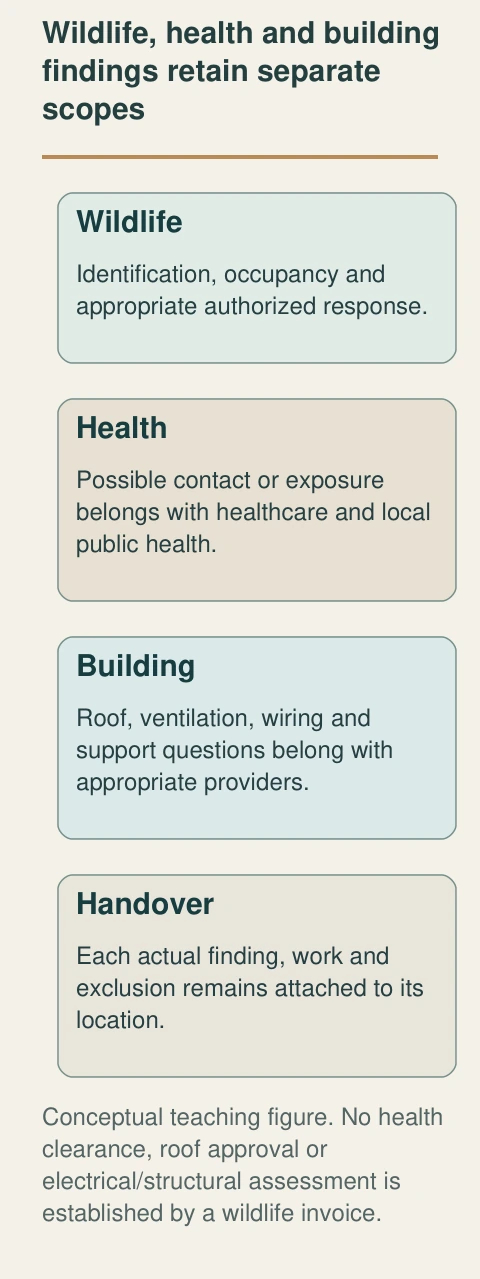
Wildlife assessment identifies the animal and response scope; healthcare addresses possible contact; building providers assess affected roof, ventilation, wiring or support. The handover keeps each finding with its own task and location.
Numbers identify the parts explained below.
What does this illustration leave out?
No health clearance, roof approval or electrical/structural assessment is established by a wildlife invoice. This illustration explains an idea. It is not an installation guide.
Which questions did the actual visit leave outside its scope?
Explore this with HomeAI ↗Opens an editable question. Nothing is sent until you choose to send it.Read the complete figure
Wildlife, health and building findings retain separate scopes
Original native teaching figure: Wildlife, health and building findings retain separate scopes. The complete labelled relationships distinguish the functions below; they describe conceptual questions rather than an actual property finding.
- Wildlife
- Identification, occupancy and appropriate authorized response.
- Health
- Possible contact or exposure belongs with healthcare and local public health.
- Building
- Roof, ventilation, wiring and support questions belong with appropriate providers.
- Handover
- Each actual finding, work and exclusion remains attached to its location.
What remains unknown: No health clearance, roof approval or electrical/structural assessment is established by a wildlife invoice.
A useful question: Which questions did the actual visit leave outside its scope?
What does follow-up establish after exclusion and repair?
Follow-up should name its question and method. It may concern the identified access route, completed repair, further signs or a separate affected-system task. A visit date is evidence of an activity; the report should say what was examined and what the finding supports. A quiet period alone should not become a permanent wildlife-free certificate.
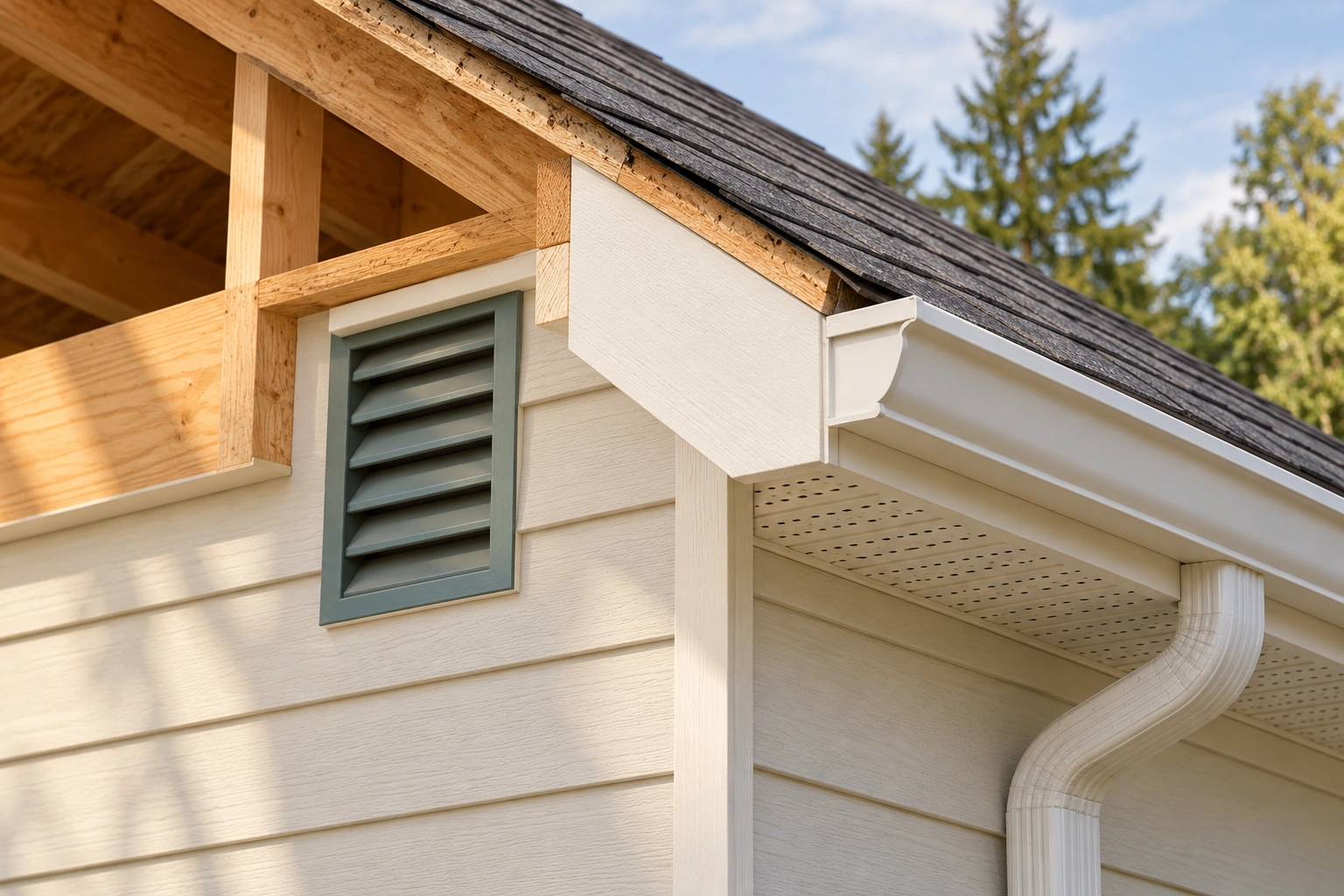
The repair-context picture shows an intact eave junction beside the original vent and gutter. It teaches the difference between an opening’s appearance and the connected project history. It contains no real exclusion, authorization, contamination or performance finding. The native completion map keeps those records separate while showing how they support the next decision.
If a new sound or sighting occurs, record its actual location and timing. Ask whether it relates to the earlier species and route, another location or a non-wildlife cause. A recurrence can justify further assessment without proving that every prior task failed. Retain the earlier scope and finding so the next provider can see what was actually completed.
Close only the task supported by its evidence. An authorized exclusion stage, a compatible roof repair and an electrical assessment may finish at different times. Keep unresolved access or material questions visible with a responsible contact. This is more useful than one broad finished label that obscures which professional still needs to answer the remaining part.
A follow-up can answer one relationship well while leaving another untested. For example, the documented repair may match the identified opening without assessing every concealed material or proving performance through all future weather. Preserve the exact result and date. Ask which new observation should prompt contact and which provider addresses it. This lets a finite completion record remain useful, rather than rejecting it for being limited or inflating it into certainty about the entire roof, every animal and every future event.
A finished roof edge has several functions to preserve
The concept shows an intact finished eave, gutter and separate wall vent beside skeletal teaching timber. The completed-looking surface illustrates repair context without claiming that exclusion, ventilation or water performance was verified.
Numbers identify the parts explained below.
What does this illustration leave out?
No actual exclusion, occupancy finding, hidden continuity, species barrier or completed repair acceptance. This illustration explains an idea. It is not an installation guide.
What does each actual completion record verify at the identified opening?
Explore this with HomeAI ↗Opens an editable question. Nothing is sent until you choose to send it.Separate completed jobs
- Wildlife scopeActual authorized work and finding.
- Building interfaceSpecified repair and retained functions.
- Affected systems/materialsAppropriate separate assessment and work.
- Follow-upBounded evidence and remaining tasks.
No permanent absence or whole-attic certification.
Further reading: Alberta · Human-wildlife conflict: Red squirrels; Alberta · Human-wildlife conflict: Bats.
How would a fictional household turn a roof sound into a scoped plan?
Noor is a fictional owner who hears intermittent sounds above a bedroom and has a ground-level photograph of an irregular rear-eave junction. A neighbour reports seeing an animal outside, but nobody has identified a species or connected it with the sound. Noor keeps those accounts separate and avoids attic entry or closing the visible opening.
The household asks a suitable wildlife professional to define identification, occupancy, current timing and authorization questions. If possible contact with an animal is reported, the appropriate medical/public-health advice is sought promptly and separately. The building provider is asked how any eventual repair would preserve the actual vent, roof and drainage functions.
In the invented assessment, the wildlife provider identifies bat-roost evidence at the rear eave but cannot determine current occupancy of the concealed continuation during that visit. The building photo separately shows an intentional vent that is not assigned as the entry route. Noor returns a quote promising immediate closure because it does not explain how the unresolved occupancy and actual species/timing requirements would be addressed. The next step is an appropriate provider plan and compatible repair scope, preserving ventilation. No vacancy, legal permission or successful exclusion is invented.
The example ends with a readable plan and an explicit unresolved question rather than a promised species, vacancy, permit or successful outcome. It supplies no actual exposure decision, inspected attic, treatment method, repair design, price or future absence guarantee. Its useful result is the connected sequence from honest observation to identification, appropriate authorization, compatible work and bounded follow-up.
What should the handover make easy to understand?
Keep the original observations, species/occupancy findings, relevant current advice, proposed stages and completed work together. Add the exact repaired locations, affected-system reports, follow-up and remaining access limits. Retain each author and date. A future provider should be able to tell which part of the account is reported, assessed, authorized or completed without assuming they are the same thing.
Use the roof guide for rain, air and assembly questions, the rodent guide for its distinct entry/food/storage enquiry, and the tree guide for canopy and utility coordination. The home-care record can retain dated service tasks and reports. Keep health information with the appropriate private record and professional; it does not belong in a public property note or photo caption.
A seller can provide the actual history without turning one repaired opening into a whole-roof renewal or pest-free claim. A buyer can ask how its scope matches the current concern. Local agreement and disclosure questions belong with the actual advisers. The educational file organizes evidence but does not establish ownership, legal compliance, insurance treatment or a transaction outcome.
The reader should finish able to explain why species, occupancy, young, timing, building functions and separate affected-system scopes all matter. They should know which safe observations help and why sealing first or entering the attic is not an appropriate investigation. That understanding supports the next responsible action while preserving uncertainty about the actual animal, route and outcome.
Keep learning about the connected parts
- Rodent signs at home: understand entry, food, shelter and the work that helps
- Understand the roof above the home you are buying
- Why damp walls and mould keep coming back
- Build a home-care record that the next person can understand
Canadian context and authorities · Visual atlas · Learning labs
Practice the distinction.
Noor keeps the sound, sighting and opening distinct
Fictional roof sound, ground-level junction photograph and neighbour report; species, occupancy and connection remain unconfirmed.
Reported observations
- The invented assessment identifies bat-roost evidence at the rear eave; current occupancy of its concealed continuation remains unresolved.
- An intentional vent is recorded separately and is not assigned as the entry route.
- No attic entry, animal contact or unplanned closure occurs.
Compare the explanations
Expand each possibility to see the evidence needed to distinguish it. Similar symptoms can have different mechanisms.
Evidence supports an identified wildlife route
A qualified assessment can guide the actual species/occupancy and authorized work questions.
Supported findings and current local/professional advice with limits.
Another location or mechanism remains
One route finding does not explain every sound, stain or concealed system.
Appropriate follow-up and separate building/electrical/material assessment.
A useful next question
Request a plan addressing the unresolved occupancy and current species/local requirements before compatible repair that preserves the actual ventilation function.
No real species, exposure clearance, permit, exclusion result, repair design or price.
Know what the words mean.
- Exclusion
- An appropriate plan intended to prevent future wildlife access, with species, occupancy, timing and authorization addressed.
- Roost
- A place used by bats for resting or other life-stage needs; its actual status requires suitable assessment.
- Occupancy finding
- A bounded professional account of whether an identified location is being used, with method and limits.
- Compatible repair
- Opening work that addresses the supported access concern while preserving the actual building and equipment functions.
Questions to bring
to the conversation.
- What was safely observed, where and when?
- What supports species, occupancy and route?
- Which current local/welfare requirements govern the actual work?
- Which building functions and affected systems need separate scope?
- What actual completion and follow-up evidence remains?
Separate a showing observation, an existing record and a new professional assessment. Unknown means a question remains; it does not automatically mean a defect.
Use the evidence planner ↗Go to the source.
Original HomeAI explanation informed by these public references. Sources support the underlying guidance; they have not reviewed or endorsed HomeAI. Diagrams are conceptual, and calculator outputs depend on your inputs.
Complete current substantive Alberta bats/squirrel, PHAC July 2026 rabies and ECCC July 2023 bird-overview bodies read October 14. Alberta context and federal, provincial and species limits retained. No handling, capture or release, trapping, line alteration, mesh/pruning dimension, legal calendar, guano-cleaning recipe, attic entry, exposure decision or actual exclusion result. ECCC linked legislation/calendars and Alberta programme/handbook not independently read. Fictional Noor case is not property evidence.
Publication & source review
First published .
Sources reviewed .
Have a question about your home?
Start with the symptom, timing and what you have observed.
Ask HomeAI