Jump to a question in this guide
- What changes when an occupied home is sold?
- Which agreements describe the present tenancy?
- Can the buyer's planned move determine the tenancy dates?
- How can a buyer assess the home respectfully?
- Which money belongs to which account?
- What property care continues while people live there?
- What should the buyer, seller and advisers each establish?
- How should alternatives be compared before committing?
- What does a fictional Alberta purchase reveal?
- What should the final occupied-home handover preserve?
- Connect the sale, present tenancy, separate accounts and supported moving plan.
- Separate actual records, reported history, safe observations and professional findings.
- Keep unresolved scope and local-law or design limits with the decision.

The home is a place of daily life. The ownership, tenancy and buyer-move cards separate the sale, existing occupancy and intended move; no card supplies an actual date or ends a tenancy.
About this illustration
No actual agreement, legal deadline, notice, vacancy or right to enter is established. This is a conceptual teaching model, not an assessment of your home.
6 picture lessons appear beside the questions in this guide. Use them to understand the explanation, then consider what it means for your home.
What changes when an occupied home is sold?
A property purchase changes who owns the interest described in the sale documents. A tenancy concerns another relationship: who may occupy the home, under which agreement and law, and with which continuing responsibilities. The buyer's intended moving day is a third matter. Those three answers need to fit together before an occupied property can support the household's plan.
Start by describing the intended outcome. Are you buying to continue the rental, to live in the whole home, or to occupy one area while another remains rented? Identify the actual premises involved. A tenant renting the whole house creates a different enquiry from a tenant renting a separate suite. The physical layout does not establish the agreement's coverage.
An accepted offer, legal completion and empty rooms are different observations. Ask your legal professional what the sale agreement promises and how the existing occupancy affects that promise. Do not infer a right to move in from the fact that the purchase price will be paid. Equally, an occupied showing does not itself mean a purchase cannot proceed.
This Canadian guide teaches the transaction enquiry, using Alberta's currently served public tenancy pages as a named provincial example. Provincial and territorial rules differ, and particular arrangements may fall under different regimes. The guide gives no notice calculation, eviction instruction, rent increase procedure or guaranteed vacant date. Your actual agreements and current local legal advice determine those answers.
The secondary-suite guide explains two households sharing a building. Here the central question is the existing tenancy through a sale, even where the home has no secondary suite. The separate moving-between-homes guide covers proceeds and funding. Neither construction approval nor available purchase cash supplies the missing occupancy answer.
One home, three separate timing questions
The home is a place of daily life. The ownership, tenancy and buyer-move cards separate the sale, existing occupancy and intended move; no card supplies an actual date or ends a tenancy.
Numbers identify the parts explained below.
- Home
Provides the occupied living space. A sale changes a separate ownership relationship.
- Ownership card
Prompts the completion question. Use actual sale documents and legal advice.
- Tenancy card
Prompts the current occupancy question. Its status needs its own agreement and local-law answer.
- Buyer-move card
Prompts the intended access question. The preferred move is not a termination result.
What does this illustration leave out?
No actual agreement, legal deadline, notice, vacancy or right to enter is established. This illustration explains an idea. It is not an installation guide.
Which actual records and advice support the tenancy, accounts and intended move?
Explore this with HomeAI ↗Opens an editable question. Nothing is sent until you choose to send it.Which agreements describe the present tenancy?
Request the complete tenancy agreement and relevant amendments through the authorized transaction process. Identify the premises, parties, starting arrangement, stated term, payments and included spaces or services. Keep schedules with the main agreement. A cropped first page can identify names while omitting the part that describes parking, storage or what happens after an initial term.
Alberta's Starting a tenancy page distinguishes fixed, periodic and hybrid arrangements. A hybrid can start with a fixed period and continue periodically through terms or later conduct. Its Rights and responsibilities page also recognizes written, oral and implied agreements. The practical lesson is to have the current relationship established, rather than assume an old written end date tells the complete story.
Ask what happened after the original document was signed. Were terms amended, additional occupants accepted or services changed? Attribute each account and retain its date. A seller's recollection, an executed amendment and the parties' actual later conduct are different forms of information for the legal reviewer. An absent written amendment does not entitle the buyer to declare that nothing changed.
If two records disagree, state the disagreement precisely. One schedule might include a garage while another summary omits it. Ask the adviser which evidence is needed to reconcile that particular point. Do not choose whichever version best fits the buyer's plans, or pressure an occupant to sign a new description during a showing.
Make a short index instead of circulating every personal document widely. The index can say which relevant records exist, who holds them and what needs legal review. Protect identification, banking and other private information. A buyer's diligence interest calls for an appropriate disclosed process, not unrestricted access to the occupant's private life.
Reconcile the agreement chain
The original lease is a starting record. Amendments and later arrangements can change what a buyer needs explained.
Numbers identify the parts explained below.
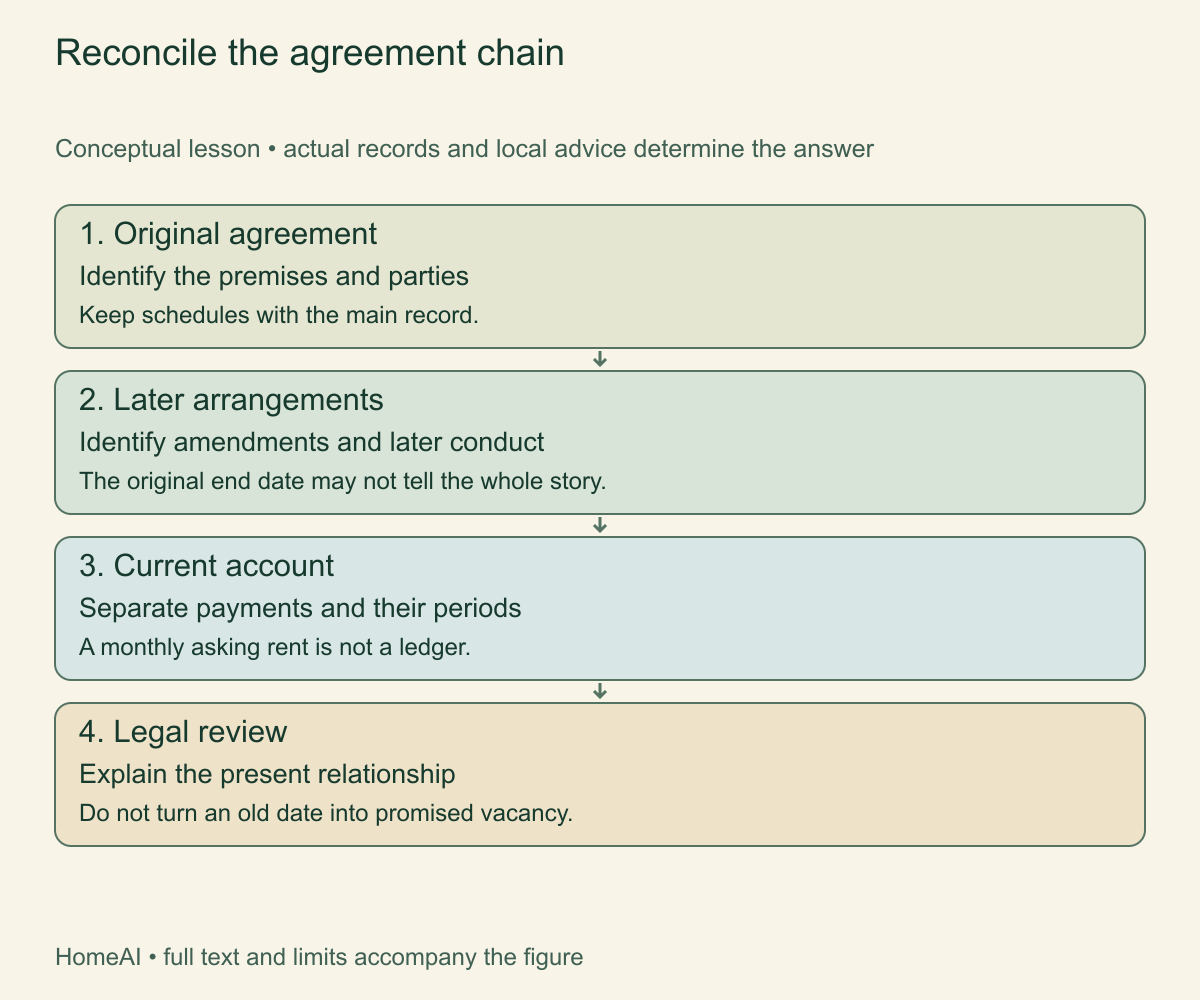
- Original agreement
Identify the premises and parties. Keep schedules with the main record.
- Later arrangements
Identify amendments and later conduct. The original end date may not tell the whole story.
- Current account
Separate payments and their periods. A monthly asking rent is not a ledger.
- Legal review
Explain the present relationship. Do not turn an old date into promised vacancy.
What does this illustration leave out?
No actual tenancy interpretation, notice calculation, account balance or vacant-possession result. This illustration explains an idea. It is not an installation guide.
Which actual records and advice support the tenancy, accounts and intended move?
Explore this with HomeAI ↗Opens an editable question. Nothing is sent until you choose to send it.Can the buyer's planned move determine the tenancy dates?
Put the proposed completion date, any tenancy dates established by the adviser and the desired household move on separate tracks. Label each as proposed, contractual, legally explained or actually completed. A date repeated in an email should not silently become a confirmed right of occupation. Identify the document and person supporting each consequential entry.
Alberta's Ending a tenancy page describes different fixed-term and periodic situations and prescribed reasons within its provincial scope. It also contains sale-related circumstances. This guide adopts the need to distinguish the actual arrangement and current grounds, without turning that page into a notice template. A buyer must not generalize one situation to every rented Canadian property.
Have the legal adviser explain whether the preferred result is feasible under the actual tenancy and proposed purchase terms. Ask which party would take any required lawful step and what would establish its outcome. A seller saying they will handle it is an undertaking to clarify, not proof that the premises will be available on the preferred day.
If dates do not fit, consider alternatives with the advisers. A different completion or move, continued rental ownership, temporary accommodation or a different property can have different practical and financial consequences. These are options to investigate, not rights the guide promises either party can impose. Changes to the transaction need the appropriate agreed and legal process.
Keep the contingency realistic. Ask which mover, storage or accommodation booking depends on actual access confirmation. A truck reservation cannot resolve a tenancy. Avoid making the household's essential housing plan depend on an unsupported assumption that a notice, conversation or sale automatically produces empty rooms on a particular day.
How can a buyer assess the home respectfully?
An occupied property is someone's home during the transaction. Coordinate visits through the appropriate representative and lawful access process. State the purpose, people involved and areas needed. Alberta's During a tenancy page distinguishes consent, notice-based access and special circumstances. Those provincial categories are not permission for a prospective buyer to enter independently or decide that an emergency exception applies.
A viewing, general inspection and specialist engagement can need different access. Ask what is authorized before booking the work. An inspector needing access to a normally closed service location should communicate that scope through the agreed process. Do not promise the specialist unrestricted entry because a showing has already occurred or because the seller supplied a key.
Record what the actual visit reached. A closed bedroom, crowded storage area or inaccessible equipment can limit evidence without proving concealment or a defect. Ask the professional to identify the exclusion and whether another authorized visit or record can address it. Avoid describing the whole building as assessed when the actual engagement covered only accessible areas.
Respect belongings and privacy. Do not open personal drawers, photograph documents, interview children or collect unrelated information about the occupant. Any property photographs should follow the authorized scope and appropriate privacy arrangements. A useful condition note identifies the component and location without unnecessarily recording the resident's possessions or personal circumstances.
Keep the technical boundary safe as well. Do not open electrical or heating cabinets, interrupt utilities, move alarms or stage leaks to demonstrate equipment. Refer specific concerns to the relevant qualified provider. If an active fire or immediate emergency is encountered, leave and contact emergency services; a purchase investigation is not the place to diagnose or test the hazard.
An occupied home needs an authorized visit
The visitor waits at the entrance while the cutaway shows a hall and a closed room. An inspection must describe the areas its authorized visit actually reaches; the picture grants no entry right.
Numbers identify the parts explained below.

- Entrance
Controls access to the home. The visitor waits outside.
- Hall
Connects the entrance with rooms. A cutaway is not actual access authorization.
- Closed room
Marks a separate private space. Unassessed areas stay explicit in the visit record.
- Follow-up
Obtains the missing scoped answer. Coordinate permission through the actual process.
What does this illustration leave out?
No actual consent, lawful notice, inspection access or concealed-room condition is shown. This illustration explains an idea. It is not an installation guide.
Which actual records and advice support the tenancy, accounts and intended move?
Explore this with HomeAI ↗Opens an editable question. Nothing is sent until you choose to send it.Which money belongs to which account?
Rent pays for occupation under the tenancy arrangement. Prepaid rent concerns a payment allocated to a future period under the actual records. A tenant's security deposit has a different purpose and treatment. The buyer's purchase deposit belongs to the property transaction. These amounts can all appear near completion, but their names and jobs must remain distinct.
Ask the legal professional to reconcile the actual rent account, payment periods, any prepaid amounts, security money and completion adjustments. Use the relevant ledger and supporting records obtained appropriately. An advertised monthly rent is neither a complete account nor confirmation that every amount has been received. Do not turn missing information into an assumed arrears figure.
Alberta's Starting a tenancy and Ending a tenancy pages separately discuss deposit handling, interest and inspection records within that province. This guide does not reproduce their rates, limits or deadlines as a purchase calculation. Ask the adviser what the actual transfer and continuing obligations require. A private agreement between seller and buyer should not be assumed to erase an occupant's rights.
Distinguish evidence of an agreed adjustment from evidence that money and records were actually dealt with. A completion statement has its own date and purpose. Keep the professional explanation of who is responsible after transfer with the relevant account records. Do not use a seller's informal statement that everything is included as the whole deposit handover.
Build the ownership budget separately. Expected rent, actual obligations, maintenance, insurance, utilities and periods without confirmed income can affect it. Neither a past payment nor a projected return promises future collection. The lender, insurer and appropriate financial adviser need accurate occupancy and agreement facts, rather than a version simplified to fit the buyer's preferred budget.
Four amounts with four jobs
Rent, prepaid rent and security money need separate accounting. The purchase deposit belongs to the property transaction and cannot replace the tenant’s account.
Numbers identify the parts explained below.
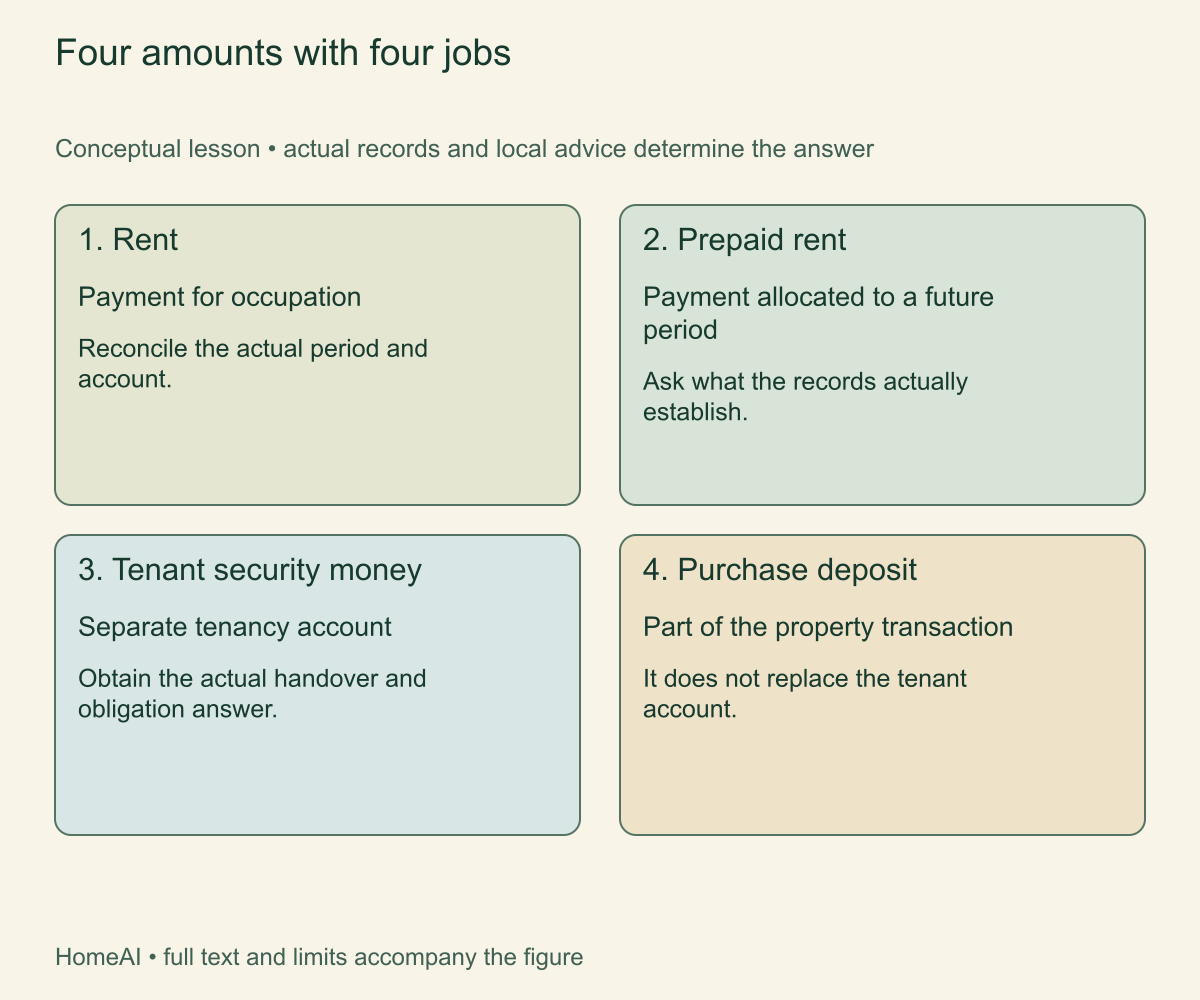
- Rent
Payment for occupation. Reconcile the actual period and account.
- Prepaid rent
Payment allocated to a future period. Ask what the records actually establish.
- Tenant security money
Separate tenancy account. Obtain the actual handover and obligation answer.
- Purchase deposit
Part of the property transaction. It does not replace the tenant account.
What does this illustration leave out?
No actual tenancy interpretation, notice calculation, account balance or vacant-possession result. This illustration explains an idea. It is not an installation guide.
Which actual records and advice support the tenancy, accounts and intended move?
Explore this with HomeAI ↗Opens an editable question. Nothing is sent until you choose to send it.What property care continues while people live there?
Ownership transfer does not make an occupied building's service questions disappear. Ask about outstanding repair requests, relevant investigations, maintenance arrangements and current provider contacts. Alberta's Rights and responsibilities page describes ongoing landlord responsibilities within its scope. Obtain local advice about the actual obligations instead of assuming a sale suspends care until the buyer settles in.
Separate a resident's reported problem from a professional finding and from completed work. A report that one room stays cold is valuable operating history, but it is not a heating diagnosis. A service appointment is planned activity, not a result. A paid invoice describes its stated task without certifying every room or every concealed component.
Ask for the appropriate equipment and building records through the representative. Link the concern to the relevant provider's scope and the areas accessed. The general inspection may identify a question that needs mechanical, electrical, plumbing or enclosure assessment. Keep recommendations open until the corresponding assessment or completion evidence exists; ownership changing hands is not technical closeout.
Clarify the practical reporting route after completion. Who receives an urgent maintenance report, who coordinates lawful access, and which provider knows the existing equipment? A clear contact arrangement helps continuity without authorizing the buyer to service unfamiliar systems. Do not publish an occupant's personal telephone number as a general property contact or disclose private repair correspondence unnecessarily.
If future renovations are part of the purchase plan, have their feasibility considered alongside occupancy and legal advice. Contractor availability, required permissions and lawful access are separate dependencies. A quotation assuming an empty building does not establish that the building will be empty. Keep construction approval and any tenancy process separate rather than treating one as authority for the other.
What should the buyer, seller and advisers each establish?
The seller supplies accurate relevant information and the agreed records through the transaction process. The buyer explains intended use and asks specific questions. The transaction representative coordinates within their role. The legal professional interprets the actual agreements, occupancy implications and completion arrangements. A technical specialist assesses a defined property question. One participant's reassurance cannot replace all those separate answers.
Write questions in a form the responsible person can answer. Instead of asking whether the rental is fine, ask which agreement currently applies to the identified premises, which account records support the completion adjustment and which outstanding work remains. Instead of asking whether the tenant will leave, ask the legal adviser what supports the proposed availability and what remains uncertain.
A request for an occupant's confirmation may be useful in an appropriate professionally advised process. The guide supplies no compulsory form, required certificate or universal right to demand one. The purpose and lawful handling need to be clear. A signed statement also has an actual scope and date; it should not be promoted into a guarantee about future events.
Tell the lender and insurer the actual arrangement and intended changes. Their responses address their own conditions and coverage. A willingness to lend does not determine tenancy rights, and a policy quotation does not establish vacant possession. If a response assumed an empty owner-occupied home, correct that premise before relying on it for an occupied purchase.
Give each unresolved item an owner and a needed answer. Missing documents, ambiguous interpretation, inaccessible technical areas and pending third-party responses are different tasks. Tracking them separately helps the household see which uncertainty affects its decision. Do not close them merely because another condition was resolved or because the completion day is approaching.
Four handover enquiries
Completion documents, service contacts and future access answer different parts of the handover.
Numbers identify the parts explained below.
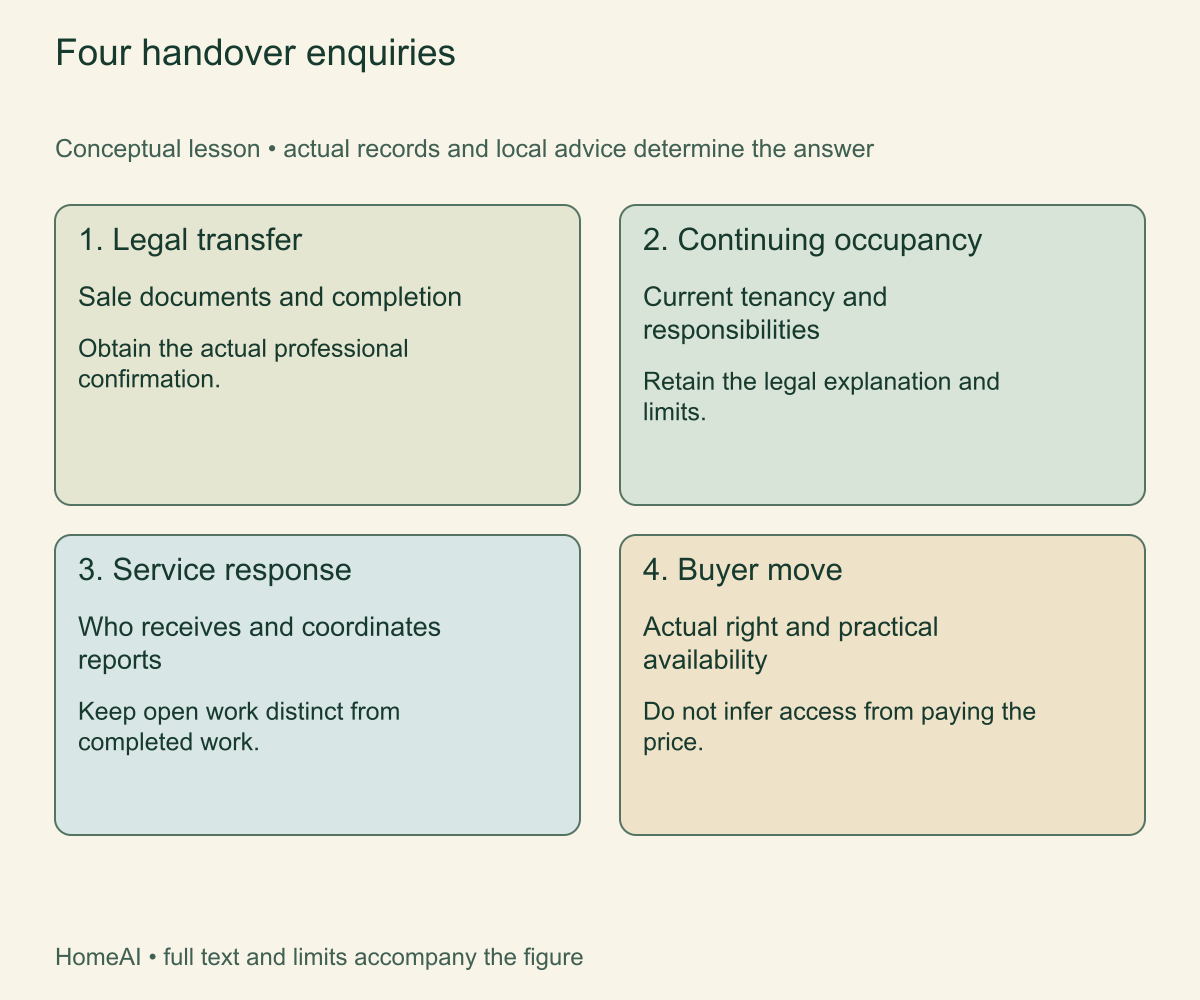
- Legal transfer
Sale documents and completion. Obtain the actual professional confirmation.
- Continuing occupancy
Current tenancy and responsibilities. Retain the legal explanation and limits.
- Service response
Who receives and coordinates reports. Keep open work distinct from completed work.
- Buyer move
Actual right and practical availability. Do not infer access from paying the price.
What does this illustration leave out?
No actual tenancy interpretation, notice calculation, account balance or vacant-possession result. This illustration explains an idea. It is not an installation guide.
Which actual records and advice support the tenancy, accounts and intended move?
Explore this with HomeAI ↗Opens an editable question. Nothing is sent until you choose to send it.How should alternatives be compared before committing?
Compare options using the same household purpose. Continuing a tenancy, moving later and choosing another property can provide different combinations of housing, income, responsibilities and uncertainty. Establish which options are legally and practically feasible before comparing costs. A cheaper assumed move is unhelpful if its occupancy premise has not been supported.
Use actual quotations where available and label other amounts as assumptions. Include accommodation, storage, moving, ownership carrying costs and properly advised rental obligations relevant to the chosen comparison. Avoid counting rent as guaranteed income while omitting maintenance or a possible timing gap. This guide supplies no yield, market rent or standardized allowance.
Dates can change more than one line. A later move may affect school arrangements, travel, accessibility, insurance and the household's current housing contract. Have the relevant provider explain each actual dependency. Preserve a dated comparison so that a change in preference can be traced to new information rather than presented as a failure of the earlier plan.
Some uncertainties concern rights rather than prices. An unconfirmed ability to occupy a room cannot always be resolved by adding a cash allowance. Ask the legal professional what the actual choices are, then decide which supported arrangement the household can accept. Do not invent a probability of vacancy or a future agreement with the occupant.
A useful decision note says what the household needs, what the documents and advisers establish, what alternative is feasible and what remains open. It should retain the tenant's situation respectfully rather than describe the resident as an obstacle to remove. The transaction needs a lawful supported plan for all affected relationships, with the buyer making an informed choice.
What does a fictional Alberta purchase reveal?
Fictional buyer Rae wants to buy an invented Alberta house and move into the whole home. The listing calls it an investment property, and the seller supplies an older agreement with a stated ending date. Rae's preferred move appears on the purchase planning calendar. No actual property, resident, account, legal conclusion or service finding is represented in this example.
Rae's legal adviser asks about the current tenancy rather than relying only on that old date. The seller reports that occupation and payments continued afterward, but the current arrangement has not yet been established. Rae records a tenancy-status question and keeps the desired move separate. This is not a finding that the resident must leave or that the transaction cannot proceed.
The authorized inspection reaches the main living areas but excludes a locked storage room. Rae retains that exclusion and requests appropriate follow-up through the representative. The buyer does not demand independent entry or assume that the occupant is hiding a problem. A separate specialist question about heating remains scoped to its actual equipment and access.
The money file also contains rent history and a reference to security money. Rae asks the legal professional to reconcile those records and the proposed completion treatment. The example invents no amount, transfer confirmation or interest calculation. Knowing the purchase deposit was received would answer a different question and would not close the tenant account enquiry.
Rae considers a later move and temporary accommodation while the actual legal answer is obtained. Any change to the purchase terms goes through the appropriate advisers and agreement process. The fictional case ends with separate questions, not a promised vacancy or a negotiated remedy. Its lesson is to connect the records before booking a move that depends on them.
Fictional decision without a promised vacancy
Rae’s preferred moving date cannot determine the tenancy. The example keeps the move dependent on the actual legal answer.
Numbers identify the parts explained below.
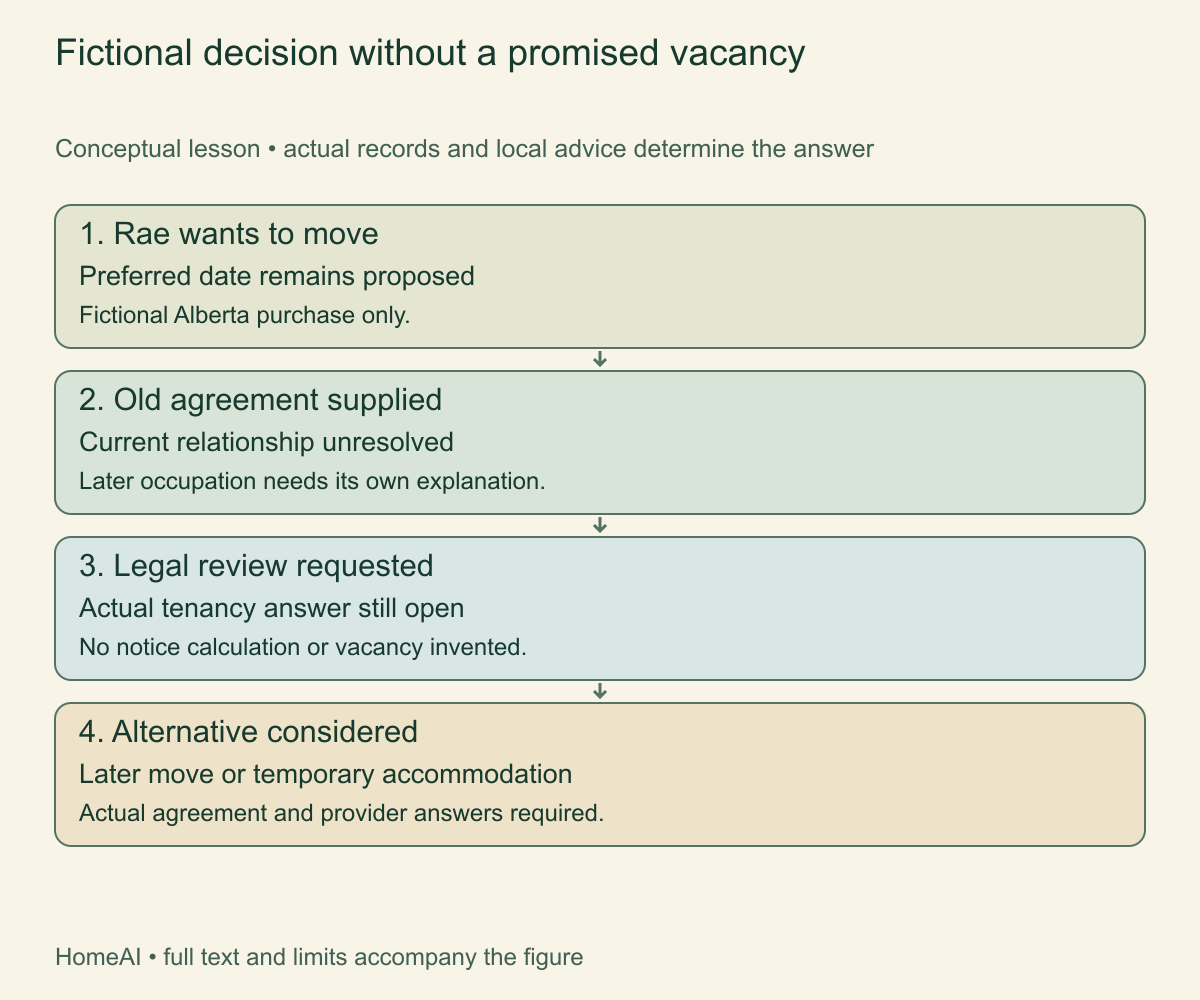
- Rae wants to move
Preferred date remains proposed. Fictional Alberta purchase only.
- Old agreement supplied
Current relationship unresolved. Later occupation needs its own explanation.
- Legal review requested
Actual tenancy answer still open. No notice calculation or vacancy invented.
- Alternative considered
Later move or temporary accommodation. Actual agreement and provider answers required.
What does this illustration leave out?
No actual tenancy interpretation, notice calculation, account balance or vacant-possession result. This illustration explains an idea. It is not an installation guide.
Which actual records and advice support the tenancy, accounts and intended move?
Explore this with HomeAI ↗Opens an editable question. Nothing is sent until you choose to send it.What should the final occupied-home handover preserve?
Keep the current tenancy record, relevant amendments, professionally explained account treatment and the actual completion confirmations securely together. Identify the premises and document versions. Store personal information appropriately, with a shareable summary limited to what each recipient needs. The new owner needs traceable information without turning the occupant's records into public marketing material.
Preserve the legal explanation of any continuing tenancy or confirmed availability, including consequential limits. A requested step, signed undertaking and completed outcome are different statuses. If a relevant issue remains unresolved, record who is addressing it and how the household should obtain the next actual answer. Keys alone do not settle every contractual or administrative task.
Attach the practical building handover: equipment identities, appropriate manuals, provider contacts, current work records and open maintenance questions. Keep reported history separate from professional findings. An ownership transfer should not erase a resident's already reported concern or make an uncompleted repair appear finished merely because the seller's folder has changed hands.
The Alberta examples come from complete currently served government pages read October 15, 2026. They illustrate agreement types, access, responsibilities and the need for a separate tenancy enquiry. Linked legislation and property-specific records were not independently interpreted here. Numeric notices, deposit rates and remedies are deliberately left to current local professional advice for the actual facts.
The useful outcome is a plain explanation: this interest transfers under these sale documents; this occupancy relationship has been established through these records and advice; these accounts and service responsibilities continue; this moving arrangement has the stated support; and these tasks remain open. That explanation lets the household act on evidence while respecting the home and people involved.
Keep learning about the connected parts
- Buying a home with a secondary suite: shared systems, records and responsibilities
- Selling one home and buying the next: money, dates and dependencies
- Read an inspection report without turning it into a guarantee
Canadian context and authorities · Visual atlas · Learning labs
Practice the distinction.
What does a fictional Alberta purchase reveal?
Fictional buyer Rae wants to buy an invented Alberta house and move into the whole home. The listing calls it an investment property, and the seller supplies an older agreement with a stated ending date. Rae's preferred move appears on the purchase planning calendar. No actual property, resident, account, legal conclusion or service finding is represented in this example.
Reported observations
- Rae's legal adviser asks about the current tenancy rather than relying only on that old date. The seller reports that occupation and payments continued afterward, but the current arrangement has not yet been established. Rae records a tenancy-status question and keeps the desired move separate. This is not a finding that the resident must leave or that the transaction cannot proceed.
- The authorized inspection reaches the main living areas but excludes a locked storage room. Rae retains that exclusion and requests appropriate follow-up through the representative. The buyer does not demand independent entry or assume that the occupant is hiding a problem. A separate specialist question about heating remains scoped to its actual equipment and access.
Compare the explanations
Expand each possibility to see the evidence needed to distinguish it. Similar symptoms can have different mechanisms.
A useful next question
Know what the words mean.
- Tenancy
- The relationship governing occupation under the actual agreement and applicable law.
- Fixed term
- An arrangement with stated dates, whose current effect requires the actual terms and local advice.
- Periodic tenancy
- An ongoing arrangement organized by tenancy periods under the actual agreement and local law.
- Hybrid tenancy
- Alberta’s description of an arrangement starting fixed and continuing periodically under terms or later conduct.
- Completion
- The property transaction stage whose requirements the legal professional explains.
- Prepaid rent
- A payment allocated to a future tenancy period under the actual records.
- Security deposit
- Tenant money with a separate purpose and legal treatment from rent and the purchase deposit.
- Vacant possession
- A transaction and legal question about availability, requiring the actual agreement and local advice.
Questions to bring
to the conversation.
- Which complete agreements and later arrangements establish the current tenancy?
- How are rent, prepaid rent, security money and purchase funds reconciled separately?
- What actual legal confirmation supports the intended move and continuing service responsibilities?
Separate a showing observation, an existing record and a new professional assessment. Unknown means a question remains; it does not automatically mean a defect.
Use the evidence planner ↗Go to the source.
Original HomeAI explanation informed by these public references. Sources support the underlying guidance; they have not reviewed or endorsed HomeAI. Diagrams are conceptual, and calculator outputs depend on your inputs.
Primary captures and adopted reading extents dated October 15, 2026. Alberta examples are provincial; CMHC 2018 editions are bounded organizational context, not updated law. NRCan source-water differences remain explicit. No actual property findings, legal/approval/financial outcome or future performance is established. Illustrations are conceptual and cases fictional.
Publication & source review
First published .
Sources reviewed .
Have a question about your home?
Start with the symptom, timing and what you have observed.
Ask HomeAI