- Identify the question, authorized parties, actual scope and applicable date before relying on a report.
- An appraiser can consider condition for valuation without performing every technical condition assessment.
- A consequential technical gap needs a relevant qualified assessment, with its own deliverable and limits.
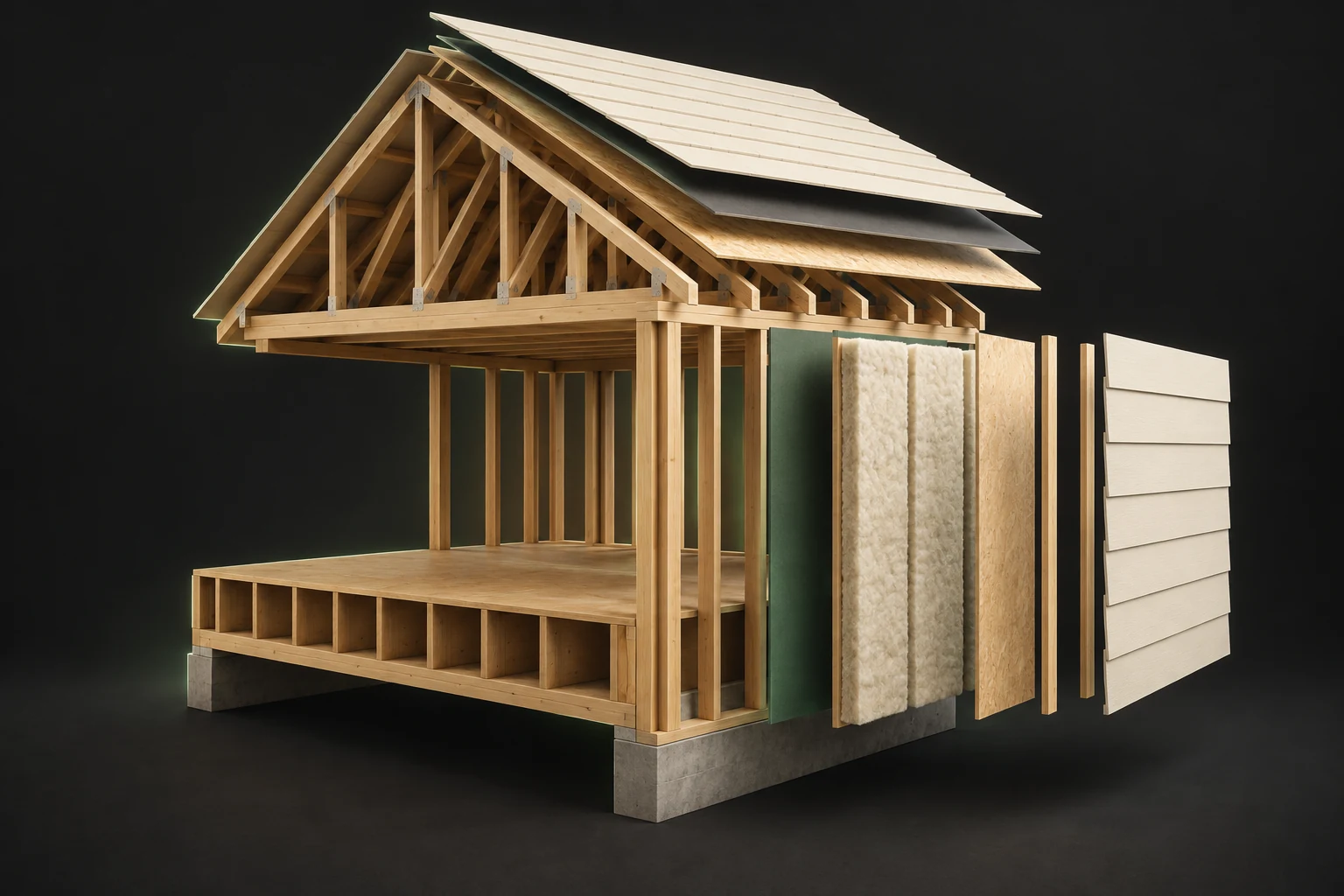
The separated planes help distinguish structure, insulation and weather-facing layers.
About this illustration
Actual layer order, material specifications, junction continuity and moisture condition require records or assessment. This is a conceptual teaching model, not an assessment of your home.
3 picture lessons appear beside the questions in this guide. Use them to understand the explanation, then consider what it means for your home.
Which question am I trying to answer?
Start with a sentence you could ask a professional. You might want an opinion of value for a defined use, information about accessible building condition, or an explanation of a recurring basement concern. All three involve the property, but they require different evidence. Write your decision beside the question: comparing a home, understanding proposed work, arranging a transaction or planning ownership. A document title should not decide the question for you.
CMHC’s current homebuying guide lists an appraiser and a home inspector as separate members of the team. It also distinguishes transaction and legal roles. This is a useful starting structure, not a complete prescription for every property. The engagement, qualifications and actual deliverable explain how a particular professional’s work fits your question.
Make an evidence index with one row per document. Include author, client, purpose, relevant date, covered property or component, method and unresolved question. An appraisal, inspection and sewer report may all belong in that index. Their presence alone does not show that concealed walls, an inaccessible roof or an entire buried service have been assessed.
Does an appraiser ignore the home’s condition?
No. AIC’s consumer guide explains that an appraiser observes characteristics and deficiencies relevant to the value assignment, then performs analysis beyond the site visit. Property characteristics, market evidence and the valuation question work together. A condition description in that report has a real purpose. It should be read for what the appraiser established and the qualifications they attached.
The distinction is the question being answered. An observation used in valuation is not automatically a diagnosis of a hidden moisture route, a structural design opinion or a measured ventilation assessment. Ask the author which condition information they used, its source and its limitations. Do not assume they performed no meaningful observation; equally, do not expand that observation into an uncommissioned technical investigation.
A seller can prepare relevant repair records, dates and equipment information for an agreed visit. Label what each record covers. An invoice identifying a roof repair is useful history without establishing the present condition of every roof detail. If an assessment needs expertise beyond the engagement, ask how the appropriate evidence should be obtained and communicated.
Trace the separate control layers
The separated planes help distinguish structure, insulation and weather-facing layers.
Numbers identify the parts explained below.
- Roof interface
Ask how the roof meets the wall and how that junction was assessed.
- Insulation space
Thickness in an illustration is not a performance rating.
- Exterior planes
A face finish does not reveal the air/water control behind it.
What does this illustration leave out?
Actual layer order, material specifications, junction continuity and moisture condition require records or assessment. This illustration explains an idea. It is not an installation guide.
Which records or qualified assessment explain the control-layer continuity and moisture limits of this assembly?
Explore this with HomeAI ↗Opens an editable question. Nothing is sent until you choose to send it.Who may use the appraisal, even if I paid for it?
Check the named parties and permitted use before treating a copy as your own report. AIC’s residential-owner guidance explains that the lender can be the appraiser’s client even when the homeowner pays the fee. Payment, receiving a document and being authorized to rely on it are separate matters. Ask the commissioning party and appraiser about access and the authorization needed for your intended use.
Current CUSPAP uses the terms Authorized Client, Authorized User and Authorized Use. They identify the engagement parties and use, rather than whoever happens to receive a forwarded file. For AIC members, the 2026 edition applies to assignments completed on or after April 1, 2026. AIC’s older consumer guide uses intended-user language; do not confuse that wording with unrestricted public reliance.
For a buyer or seller, the practical question is precise: “Can I rely on this report for this purpose, and what written authorization or separate engagement is required?” Keep the answer with the report. Do not remove qualifications or circulate a confidential document to contractors merely because its fee appeared among your transaction costs.
Why do the valuation date and visit date differ?
A report can involve more than one meaningful date. CUSPAP distinguishes the effective date of an opinion from the inspection and report dates. Ask which date the opinion addresses. A historical value question, a current assignment and a prospective assignment describe different time contexts. The date on an email forwarding the file does not update any of them.
Build a small chronology for your property question: dated observations, supplied repair information, the report’s stated dates and subsequent changes. Do not infer order where a record is undated. A recently delivered report might concern an earlier date, while a later repair may change the condition information available to another professional.
If the home, available evidence or intended use has changed, ask the author what further work is appropriate. Do not relabel an older opinion current yourself. Similarly, a recent condition inspection describes the assessment under its own conditions; it does not establish every past event or future outcome. Dates help compare the documents without demanding that each tell the same story.
What does the actual scope tell me?
Read what the professional was engaged to do and what they actually did. An appraisal’s scope identifies research, observation, analysis and relevant limitations for its authorized use. Ask for clarification when a condition description does not explain the information source. Report length or a templated format alone is an unreliable shortcut for deciding what was investigated.
For a home inspection, ask which systems, access and methods the agreement includes. CAHPI’s 2024 practice standard describes accessible visual assessment for members, allows appropriately qualified additional services and identifies exclusions. It does not make every inspection technically exhaustive. A separate booked service can add evidence; the word inspection does not automatically include every available test.
Alberta requires a written inspector contract and a report addressing contracted items. Consumer Protection BC describes contract coverage, visual limits and expert-advice recommendations. These are jurisdiction-specific examples. Keep a coverage gap identifiable: a snow-covered roof, a locked room and an unbooked sewer camera assessment are different gaps with different potential next steps.
Roof, heat and snow interact
The scene illustrates several interacting systems; it does not identify a cause or snow capacity.
Numbers identify the parts explained below.
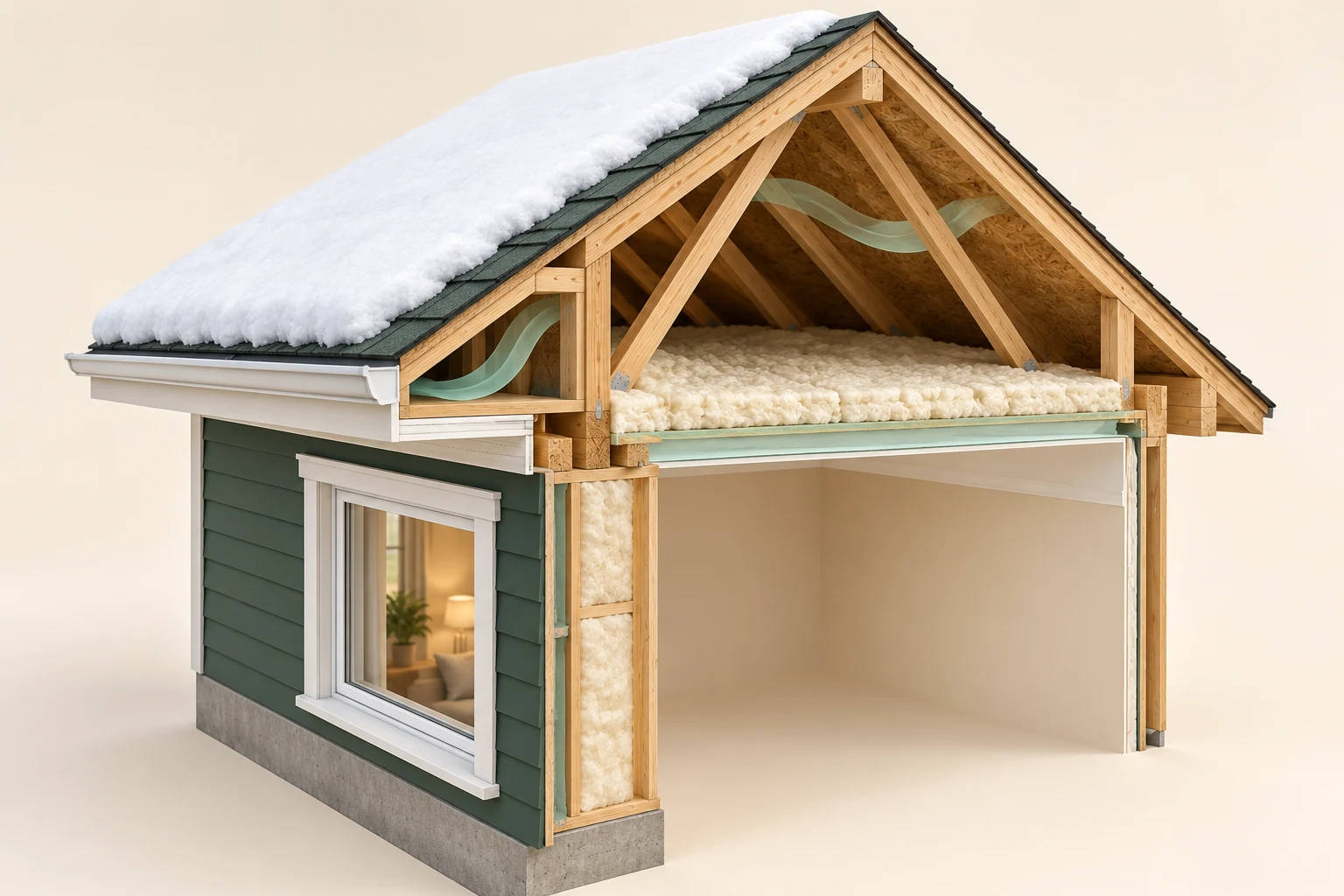
- Roof conditions
Record location and timing from safe ground access.
- Ceiling interface
A stain does not establish roof versus condensation cause.
- Indoor conditions
Weather, indoor moisture and operation can matter together.
What does this illustration leave out?
Snow load, leak location, heat loss, moisture and structural adequacy require separate evidence. This illustration explains an idea. It is not an installation guide.
Which safe-ground observations and records distinguish snow, roof drainage and indoor moisture explanations?
Explore this with HomeAI ↗Opens an editable question. Nothing is sent until you choose to send it.When is an assumption different from a finding?
Look for statements that depend on information being true rather than established by the assessment. CUSPAP requires reported assumptions and limitations; an extraordinary assumption concerns uncertain information capable of materially changing the conclusion if untrue. Ask the author to explain the relevant assumption and what evidence could affect it. This is a report-reading task, not a reason to rewrite the value yourself.
Use three separate fields in your notes: what was observed, what was supplied by someone else, and what was assumed for the analysis. For example, an owner’s description of a repair remains attributed history unless the available records support the particular claim being made. A professional may explain how they used that information; do not silently promote it to independently verified work.
When a new document appears, preserve its scope too. A specialist’s finding in one location might resolve one assumption while leaving another question open. Send the complete relevant evidence through the authorized route and ask the report author about implications. The buyer should not assign an unsupported value adjustment from a photograph or a repair estimate.
What can a specialist add that another report leaves open?
A specialist engagement begins with a narrow technical question. Is a reported moisture pattern associated with a source that affects a planned basement use? What does an observed pipe condition mean along the reached camera route? Which existing information is needed to assess a proposed opening? Let the appropriately qualified professional define suitable methods, access and limits for that question.
A camera assessment can provide evidence about the reached visible interior; it cannot automatically answer every question about surrounding soil, external support or an unreached segment. A quotation can describe proposed work without being a complete diagnostic assessment. Ask which service is being offered and which conclusion its deliverable can support. The sewer companion guide explains these method boundaries in depth.
Request location, assessment date, method, conditions, findings, interpretation and remaining uncertainty. Obtain permission for any additional access through the property process. Buyers should not open finishes, electrical equipment or contaminated cleanouts to fill the gap themselves. A better evidence brief is safer and more useful than attempting to complete an unperformed assessment.
Water comes in; used water leaves through a different system
Supply pipes bring water to taps and appliances. After use, water leaves each sink through a drain and trap before joining the larger drainage route. The trap holds a water seal that limits gas passage into the room. Venting lets air circulate in the drainage system and helps protect those seals. Following these different jobs makes a repair record much clearer than calling everything plumbing.
Numbers identify the parts explained below.
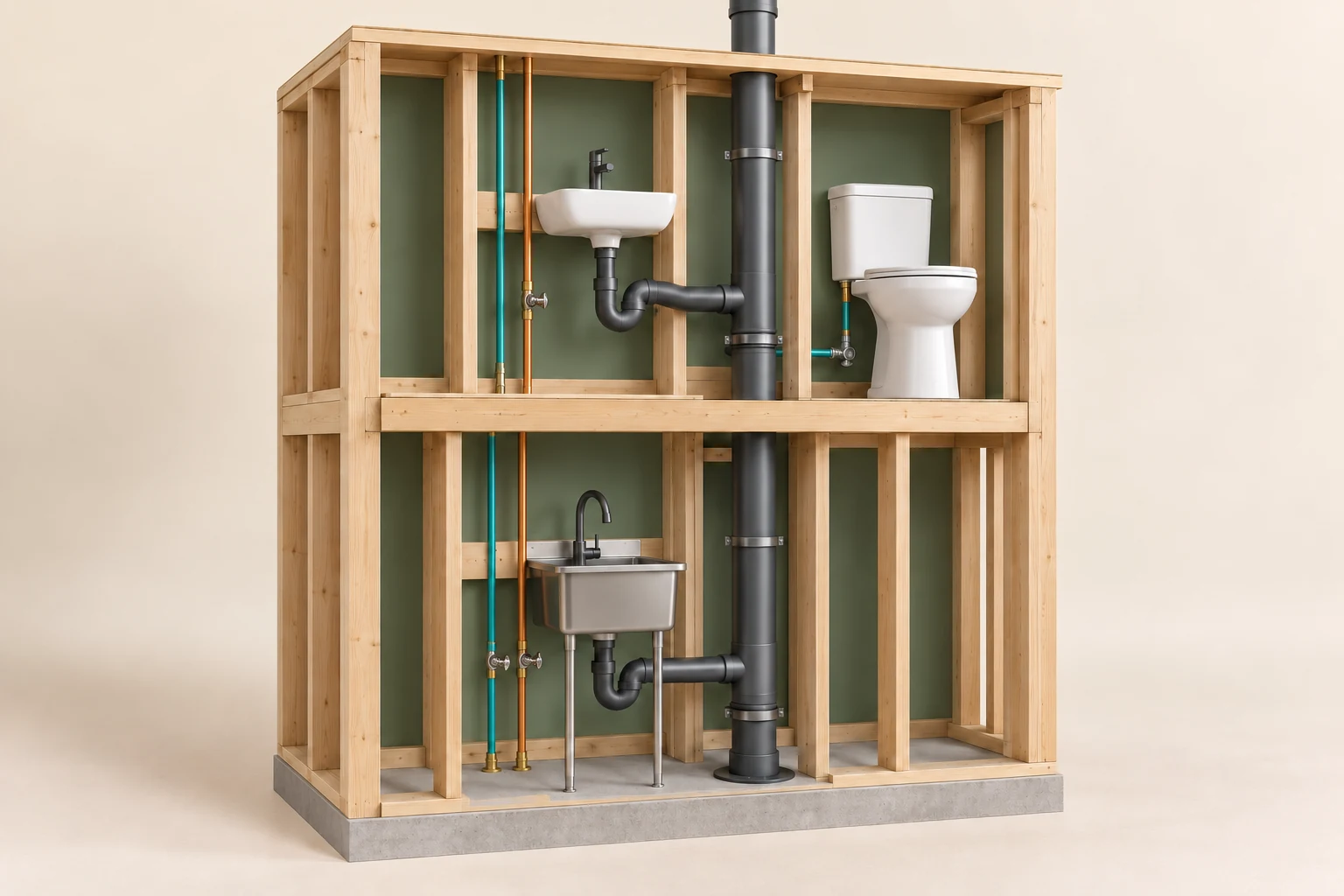
- Water supply
The narrow runs illustrate water delivery to fixtures. Incoming pressure provides the push; the drains carry used water away separately. A supply replacement record should name the branches and endpoints it covers.
- Sink trap
Water retained in an installed trap forms a barrier against gas from the drain. The curved shape helps locate that part here, but the picture does not show its retained water or establish its condition.
- Drainage and venting
The larger vertical pipe illustrates a stack carrying drainage between floors. Venting has the separate air-circulation and trap-protection job. Ask where each fixture drains and how its trap is vented; those complete connections are not drawn.
What does this illustration leave out?
The cutaway omits the tap connections, water inside the traps and a complete vent route to outside air. Pipe colour does not identify material. Ask a qualified plumber to explain the actual arrangement; this picture supplies no local design or approval. This illustration explains an idea. It is not an installation guide.
Which pipes supply this fixture, where does its used water go, and how does the actual vent arrangement protect its trap seal?
Explore this with HomeAI ↗Opens an editable question. Nothing is sent until you choose to send it.Which questions belong with which professional?
For the appraiser, ask: which property interest and defined value question were assessed, for whose use, at what date, using which relevant condition information? Request an explanation of consequential assumptions. For the inspector, ask: which accessible systems were assessed, which methods were included, what findings need attention, and what was outside the engagement? Their responses belong in separate rows even when both discuss the same room.
For a specialist, state the specific component and decision, then ask what assessment can answer it and what remains outside that scope. For the municipality or relevant authority, ask what the actual record establishes and whether its status needs clarification. For your legal professional, ask about permitted reliance, access and the purchase agreement. A technical author should not be asked to decide a contractual remedy merely because they identified a concern.
This question-to-professional map is an organizing tool, not an exclusive list of services anyone may provide. Some professionals have additional verified qualifications and offer separately scoped work. Confirm those qualifications and the booked deliverable. A shared employer, common logo or introduction does not merge the roles into one blanket approval of the property.
How would these differences matter in a fictional purchase?
Fictional example: a buyer considers an invented home with a finished basement. A valuation assignment is commissioned for a named lender. The seller describes an earlier basement repair. A separate inspection records a stain and restricted visibility behind stored belongings, recommending further assessment. No actual property, lender decision, appraised amount or defect is represented here.
The buyer records three different facts: a described valuation engagement, an attributed repair statement and an invented inspection finding with an access limit. They ask about their authorized access to and use of the appraisal. They ask the inspector to clarify the consequential condition gap and arrange an appropriate moisture assessment through agreed access. They do not treat the valuation engagement as proof that the basement concern was resolved.
If a specialist supplies new evidence, the buyer preserves its location, methods and limits and consults the relevant authors and transaction advisers. That evidence might affect several conversations without automatically cancelling an agreement, changing a valuation or establishing repair responsibility. The worked example ends with a better evidence plan; it supplies no buying recommendation or predicted outcome.
What should the combined property record preserve?
Keep full reports, agreements and authorized clarification together. Record the property identity, document version, relevant dates, information source and intended decision. Link a follow-up to the original question rather than deleting the qualified statement that prompted it. A short summary is useful when another person can still retrieve the supporting detail.
If reports seem inconsistent, ask whether they concern the same location, date, method and question. A visible condition note, a value conclusion and an estimated repair scope need not conflict simply because their wording differs. Where a genuine disagreement remains, ask the relevant qualified authors to explain the difference. Avoid selecting the most reassuring sentence while dropping its assumptions.
Before committing to a decision, identify unresolved evidence and discuss its significance with your advisers under the actual transaction. After purchase, keep applicable technical findings in the Home Plan for maintenance or further work. HomeAI can help organize the record and prepare clearer questions; the authors’ scope and the property-specific evidence determine what each answer establishes.
Keep learning about the connected parts
Practice the distinction.
Fictional home: three documents, three questions
An invented valuation assignment for a named lender, an attributed basement-repair statement and a limited inspection finding are available. No value, technical diagnosis or lending outcome is supplied.
Reported observations
- The described appraisal engagement is for a specified party and use.
- The repair statement is attributed to the fictional seller.
- The fictional inspector records a stain and a visibility limit.
Compare the explanations
Expand each possibility to see the evidence needed to distinguish it. Similar symptoms can have different mechanisms.
The available engagements can be useful within their scopes
Each can inform a different question without resolving every technical uncertainty.
Full engagement, report, information sources, dates and author clarification.
A consequential condition question remains open
The basement history and limited view do not establish a source or repair outcome.
Agreed access and an appropriately qualified, location-specific assessment.
A useful next question
Clarify authorized report use and commission the relevant technical evidence through the property process, preserving each deliverable’s limits.
No actual appraisal, measured property, purchase advice, value adjustment, defect or legal remedy is represented.
Know what the words mean.
- Authorized user
- A party identified and authorized for the appraisal engagement; receiving a forwarded copy does not establish that status.
- Authorized use
- The use permitted for the appraisal service through its engagement.
- Effective date
- The date the appraisal opinion addresses, which can differ from the visit or report date.
- Scope of work
- The agreed assessment, research and analysis, with the applicable methods and limits.
- Extraordinary assumption
- Uncertain information assumed for an appraisal that could materially change its conclusion if untrue.
- Targeted assessment
- Professional work selected to answer a defined technical question rather than assess every aspect of a property.
Questions to bring
to the conversation.
- What purpose and use does this report state, and who is authorized to rely on it?
- Which date does the value opinion concern, and when were observations and the report made?
- What was observed, researched, measured, assumed or excluded?
- Which unresolved question needs a general inspection, a specific specialist, an official record or legal interpretation?
- Has a later finding been sent through the permitted route to the relevant report author?
Separate a showing observation, an existing record and a new professional assessment. Unknown means a question remains; it does not automatically mean a defect.
Use the evidence planner ↗Go to the source.
Original HomeAI explanation informed by these public references. Sources support the underlying guidance; they have not reviewed or endorsed HomeAI. Diagrams are conceptual, and calculator outputs depend on your inputs.
Publication & source review
First published .
Sources reviewed .
- Appraisal Institute of Canada — current CUSPAP edition
- Appraisal Institute of Canada — CUSPAP 2026
- Appraisal Institute of Canada — consumer appraisal guide
- Appraisal Institute of Canada — residential property owners
- CMHC — Homebuying Step by Step, current guide
- Office of Consumer Affairs — home inspections
- Alberta — hiring a home inspector
- Consumer Protection BC — home inspections
- CAHPI — 2024 National Standards of Practice
Have a question about your home?
Start with the symptom, timing and what you have observed.
Ask HomeAI