- Separate water quantity, untreated quality and treatment performance.
- Use the laboratory and local health authority to choose sampling locations and parameters.
- Keep well, treatment and event records together without treating one negative sample as permanent clearance.
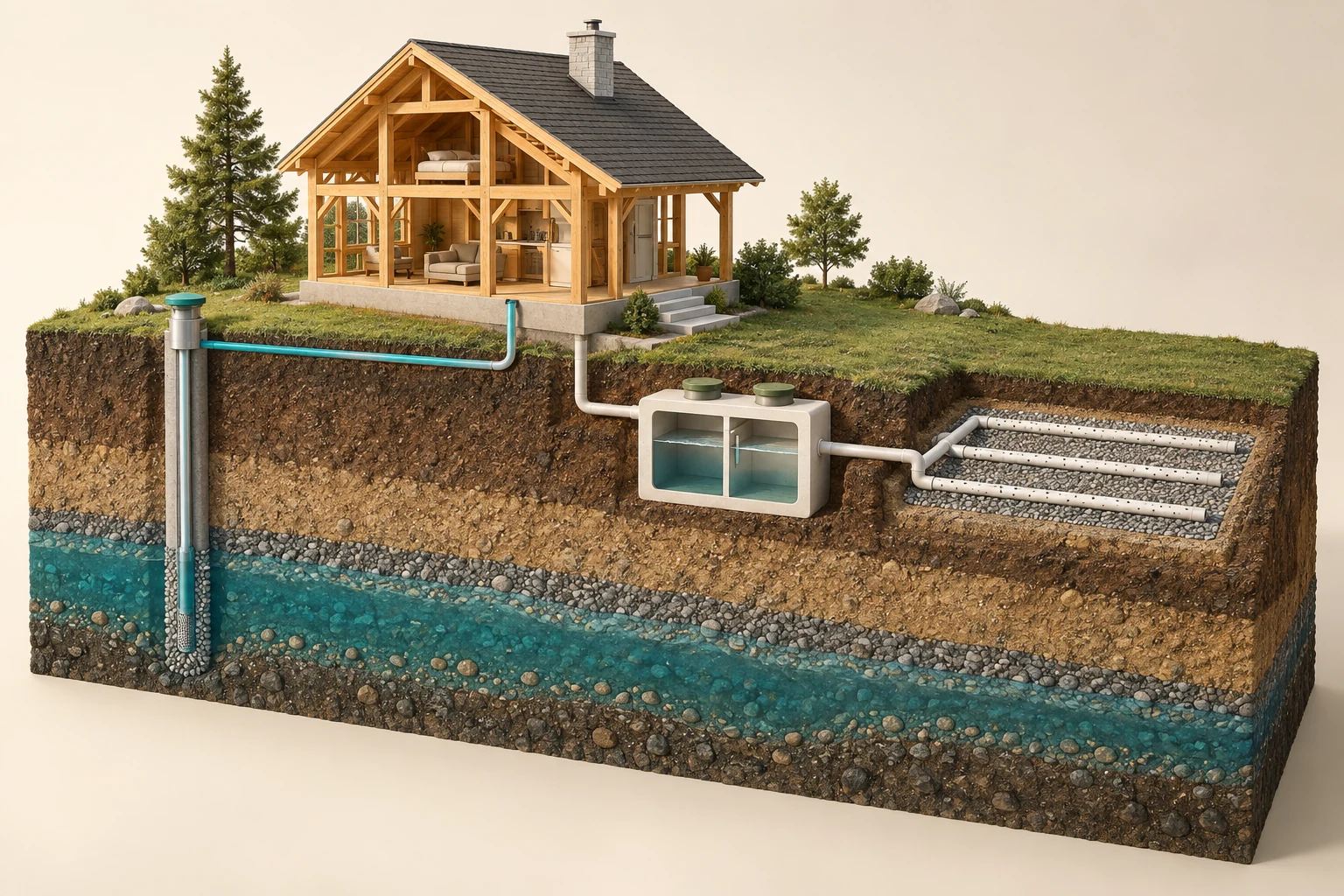
Conceptual architecture. Layout, sizes and routes are illustrative; the picture does not describe your home’s condition.
Explore this picture study ↗4 picture lessons appear beside the questions in this guide. Use them to understand the explanation, then consider what it means for your home.
Map the service before judging its water
A private supply is a chain: groundwater reaches the well, pumping moves it into the home, pressure equipment supports delivery, and any treatment changes selected properties before a fixture is used. A successful shower demonstrates delivery at that moment. It does not identify the source chemistry or establish that a treatment device is operating correctly. Begin with a simple record of the components that actually exist, rather than an idealised rural-house diagram.
Collect an available well record, equipment model labels, treatment manuals and the names of the people who last serviced the system. Mark uncertainty openly: an unidentified cartridge is an unidentified cartridge, not a presumed drinking-water safeguard. Keep untreated and treated sampling locations distinct in the record. If plumbing has been altered, ask the service professional to confirm which taps bypass treatment and which supply the water normally consumed.
The useful question is what each part is intended to do and how that function is checked. Pump performance, well yield, pressure stability and contaminant removal may require different methods. A single service invoice rarely answers all four. This map helps the laboratory, well contractor and treatment specialist agree on the decision before someone recommends a product.
Delivery hardware does not establish quality or sustainable supply
The teal main route crosses the room from the left well section toward the kitchen fixture. A short branch rises from that route into the base of a closed blue tank. A dial-like face and closed grey enclosure sit nearby. The house and ground are virtual cutaways.
Numbers identify the parts explained below.
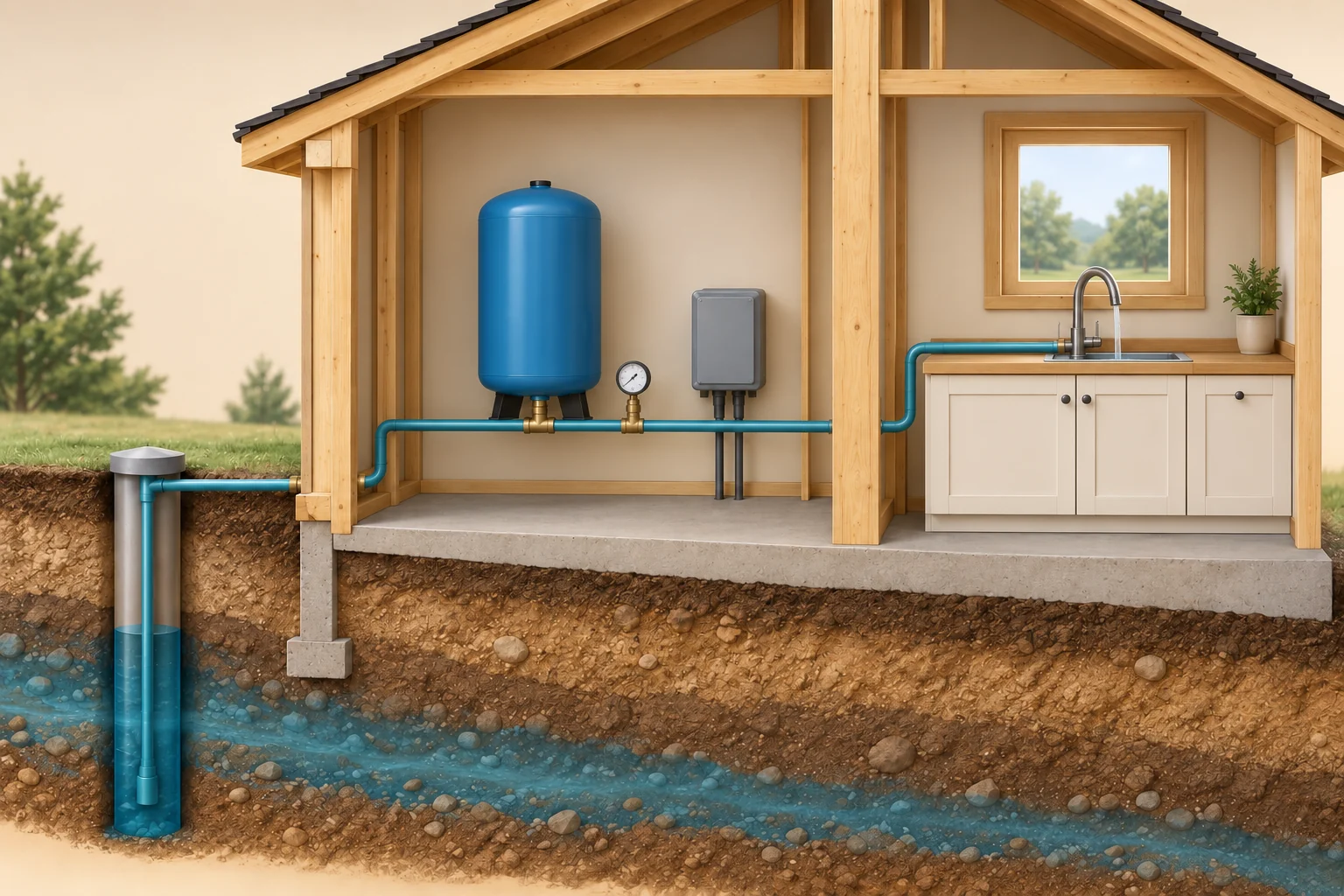
- Source-location specimen
Match the actual well identity, source and construction records to the home. This pictured well cannot establish source replenishment or water quality.
- Closed delivery equipment
The tank, dial-like face and closed control are separate equipment landmarks. Identify actual models and scoped service findings rather than reading performance from their appearance.
- Fixture landmark
Ordinary delivery at a fixture answers a narrower question than source quantity or laboratory quality. The illustration depicts no flow test or measured result.
What does this illustration leave out?
The apparent route is a teaching simplification, not a verified pressure-piping installation or actual pump connection. No model, fuel or energy state, measured pressure, seasonal yield, usable tank storage, groundwater flow, water quality or treatment performance is established. The gauge supplies no usable reading. Keep real covers closed and do not operate or adjust equipment to reproduce the scene. This illustration explains an idea. It is not an installation guide.
Which source, equipment and route records establish how this home receives water, and what separate evidence addresses water quality and supply quantity?
Explore this with HomeAI ↗Opens an editable question. Nothing is sent until you choose to send it.Choose a testing question, not just a bottle
Health Canada recommends microbial testing at least every six months and general water-quality testing every two years, with chemical testing shaped by local advice. Its guidance also calls for attention after events such as flooding, well work or changes around the source. These are planning references, not a substitute for provincial or local public-health directions, a current advisory or an existing treatment monitoring plan.
A bacterial screen and a chemical analysis are different evidence. In Ontario, public bacterial testing does not also establish the absence of chemical contaminants. Elsewhere, the laboratory service, available parameters and submission arrangements may differ. Ask what the proposed panel measures, why those parameters fit the location, and which important concerns remain outside it. Nearby land use and geological context help shape a question; they do not diagnose the contents of a particular well.
Give the laboratory the sample's intended purpose. A sample before treatment may investigate the source, while a sample after treatment may investigate delivered water. Comparing them can be valuable only when collection and interpretation suit that comparison. Request instructions for the actual containers, collection point, handling and delivery window before collecting anything.
A sample report needs its actual collection point and context
A left faucet and a kitchen faucet sit at different illustrated locations around an unnamed closed cream cabinet. Two capped clear bottles, a blank sheet and a blank clipboard lie separately in front. A virtual well section appears at left.
Numbers identify the parts explained below.
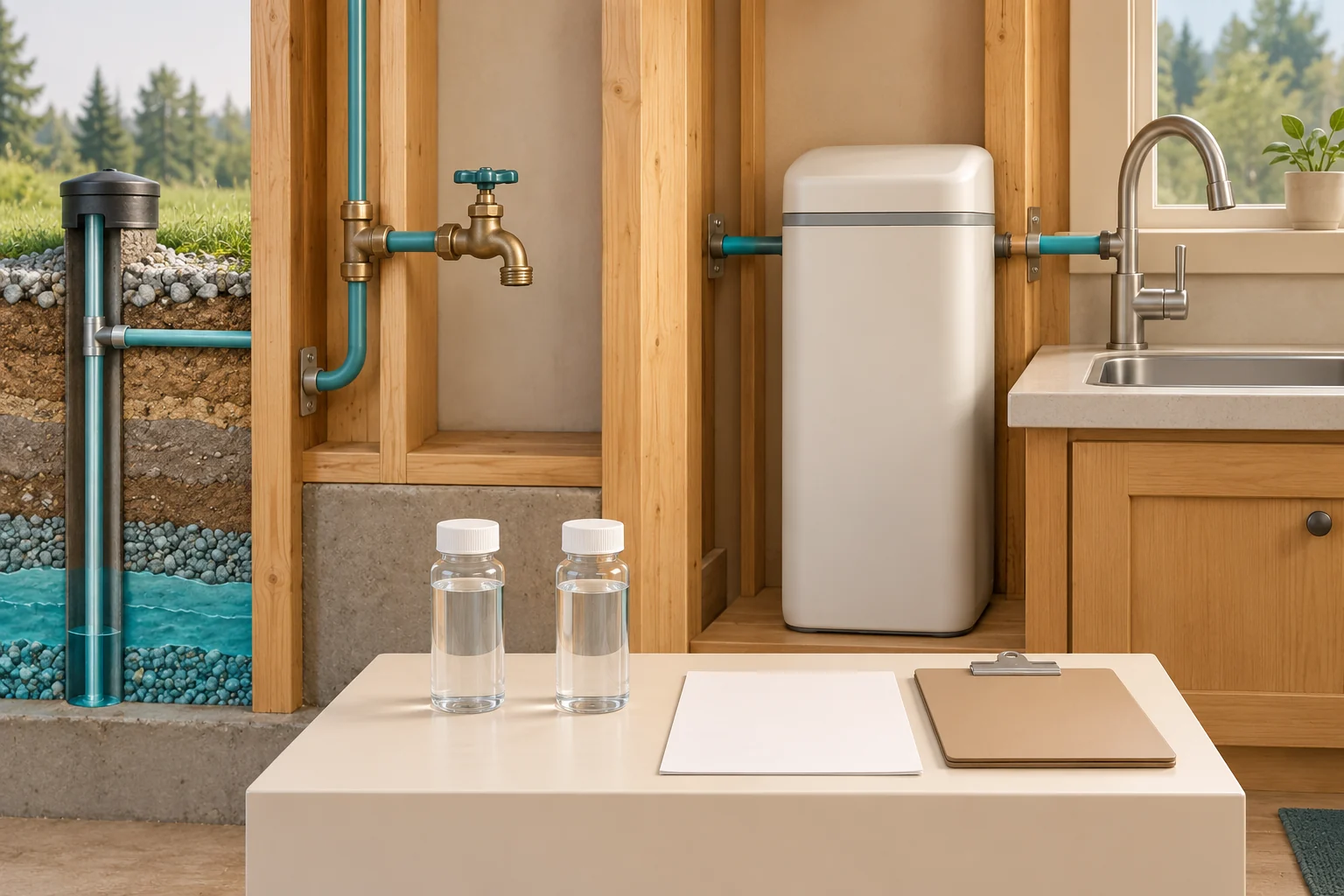
- Separate location landmarks
Ask the laboratory and provider to identify the actual collection point and relevant treatment state. Neither pictured faucet is a prescribed sampling location.
- Capped sample specimens
The bottles show no collection procedure or tested finding. Follow the actual laboratory instructions for containers, collection, identification, handling and delivery.
- Original report question
Retain the actual date, panel, method and collection context. Microbial and chemical questions are different; blank paperwork cannot answer either.
What does this illustration leave out?
No bottle has an authenticated collection point, panel, result or handling history. The cabinet does not identify actual treatment, and its illustrated position cannot establish raw or treated water at either faucet. Blank pages supply no date, method, analytes, concentrations or drinking-water clearance. These are location and record questions, not approved sampling instructions. This illustration explains an idea. It is not an installation guide.
Which actual sampling point, treatment state, collection date, laboratory panel and instructions belong to this result?
Explore this with HomeAI ↗Opens an editable question. Nothing is sent until you choose to send it.Preserve the circumstances around a result
A laboratory report is an observation of a submitted sample with specified methods. Its date, location, collection conditions and measured parameters define its reach. Write down recent rainfall or flooding, whether the home was occupied normally, recent equipment work, and which treatment was operating. Missing context is a reason to ask a better question, not a reason to discard a result automatically.
The distinction between an organism detected and an organism not detected must retain the report's wording. An E. coli finding needs prompt advice from the local health authority and a safe alternative drinking-water arrangement; do not continue using suspect water while waiting for HomeAI to interpret it. Total-coliform findings need their own interpretation and follow-up. Do not convert every possible laboratory flag into the same diagnosis.
If chemical contamination is possible, boiling is not a general solution. Ask the authority about safe water for drinking, food preparation and other relevant uses. HomeAI can help organise the questions, but it cannot select a disinfection dose, declare water potable from a photograph, or override laboratory or public-health instructions.
Observe the wellhead without dismantling it
From safe accessible ground, document the visible wellhead, surrounding surface condition and any pooling after weather. Note apparent damage, a missing identification record or recent nearby work. Health Canada's protection guidance emphasises keeping the well protected and inspecting its accessible condition. Photographs support a conversation about the pathway around a source; they cannot establish the condition of buried seals or the aquifer.
Do not remove a cap, enter a well pit, probe wiring or try to repair a pump to complete the record. Tanks, pits and wells can involve confined-space, electrical and contamination hazards. Ask the appropriately qualified contractor to investigate components that require access. An owner can maintain an uncluttered record and report changes without turning routine observation into intrusive testing.
A new puddle might reflect surface drainage, settlement or a different weather event. Record its position and timing rather than naming a contaminant route. A contractor can explain whether further wellhead, construction or drainage investigation is justified. Local construction and separation requirements must come from the responsible jurisdiction; an educational diagram is not a setback plan.
The visible wellhead and concealed protection need separate evidence
A closed cap and casing stand above grass. The virtual soil section exposes grey strips beside the casing and a teal band lower in the rock. A house sits in the background.
Numbers identify the parts explained below.
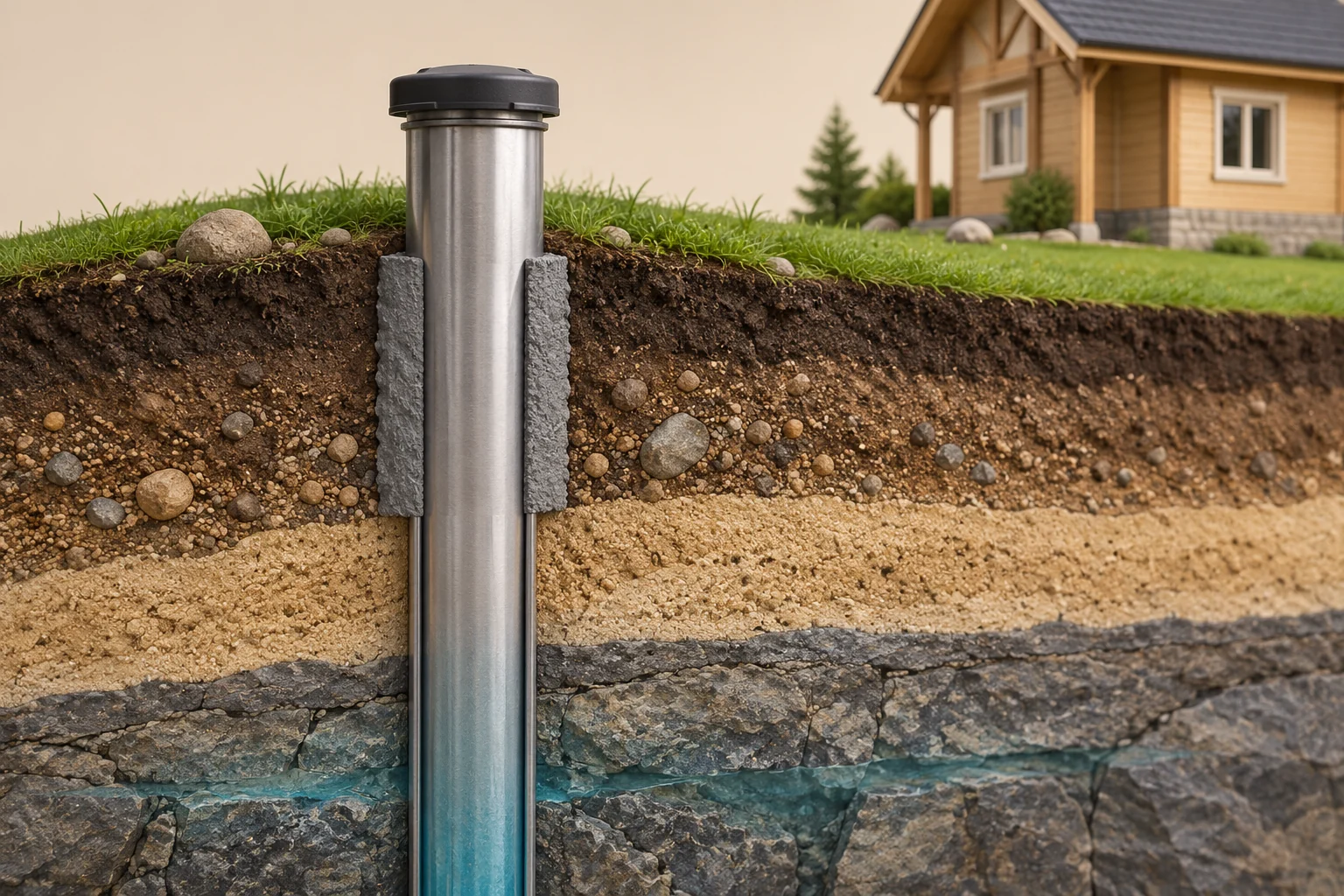
- Closed cap and accessible casing
Record accessible exterior condition from safe ground. Do not remove the cap, lean over an opening or enter a pit to match the picture.
- Concealed interface specimen
Health Canada distinguishes casing and annular-seal protection. This grey display supplies no finding about the real buried seal; request construction records and qualified findings.
- Surface and surroundings
Keep the actual location, pooling timing and nearby changes in the record. This pictured grass and ground supply no contamination or drainage clearance.
What does this illustration leave out?
The grey strips introduce a concealed-seal question without authenticating an annular seal, its material or integrity. Teal colouring establishes no groundwater direction, contamination or sample result. Actual construction, buried condition, surface drainage, local requirements and appropriate separation remain unknown. The section is an illustration, not an opened well, installation detail or setback plan. This illustration explains an idea. It is not an installation guide.
Which accessible wellhead changes and original construction records should I show a qualified local well professional without removing a cap or entering a pit?
Explore this with HomeAI ↗Opens an editable question. Nothing is sent until you choose to send it.Match treatment to a demonstrated target
Treatment is selected for a defined problem and operating conditions. A filter, softener and ultraviolet device are not interchangeable. Health Canada's treatment guidance distinguishes contaminant-specific methods and the need to verify performance. A reassuring equipment label is insufficient when the relevant contaminant, water characteristics or maintenance history is unknown.
Ask for the treatment design basis in plain language: what is being reduced, what incoming-water conditions the device needs, what routine service preserves its function, and what measurement shows the objective is met. The answer should distinguish installed hardware from demonstrated performance. Keep the intended target beside the model and service information so a future owner does not misinterpret a device's purpose.
Replacement dates alone can hide differences in use. A vacant seasonal home and an occupied household may place different demands on the same equipment. Follow the actual manual and specialist plan rather than substituting a generic cartridge calendar. If the system's purpose or verification method cannot be explained, resolve that gap before relying on it for drinking-water quality.
Different treatment functions need a defined target and verification
Three separate display stands expose a pleated cartridge, bead and pellet forms in paired vessels, and a tube-and-sleeve form inside a metal cylinder. Control faces and electrical connections remain closed. These interiors are virtual cutaways.
Numbers identify the parts explained below.
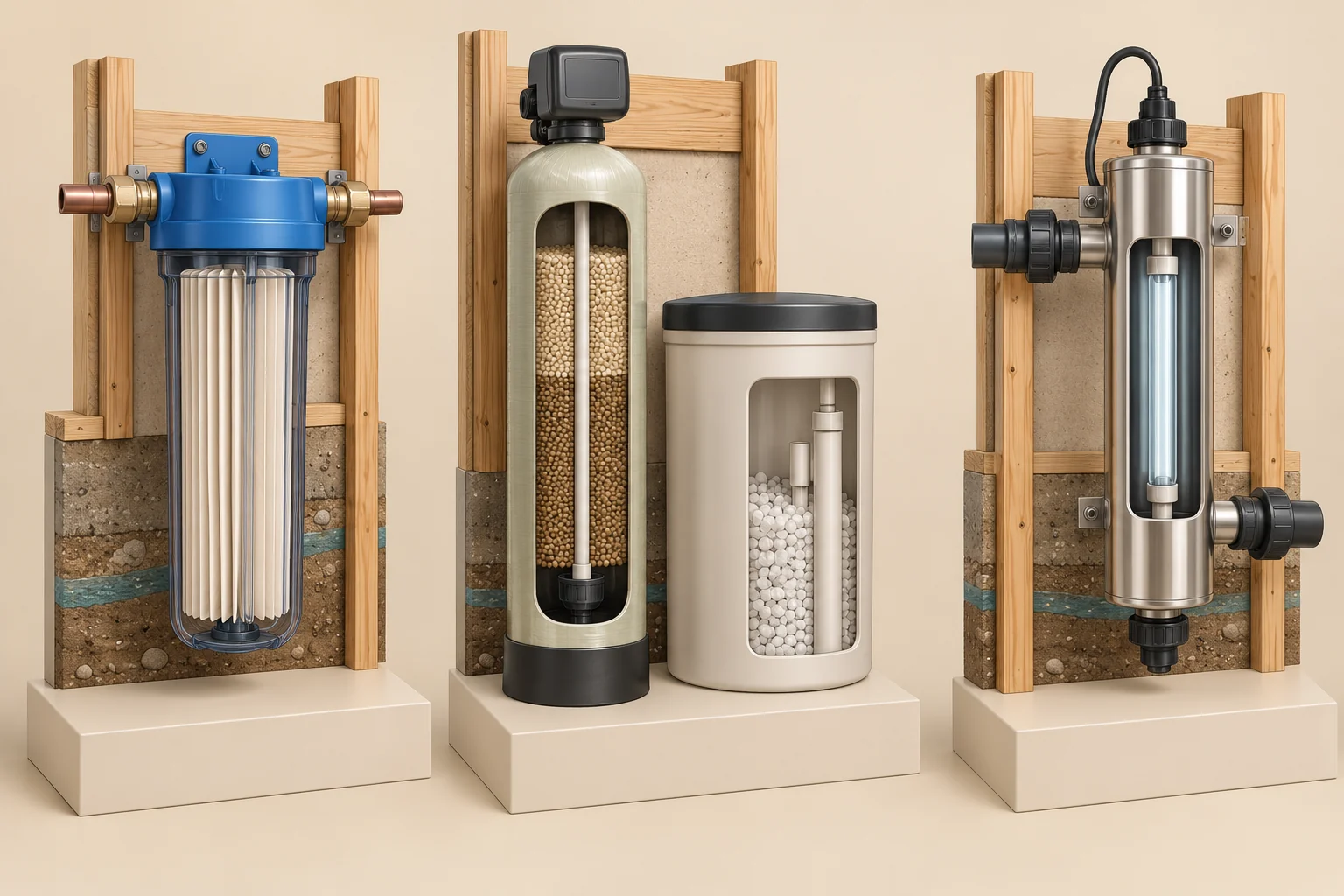
- Cartridge specimen
A pleated shape introduces a filtration question. The actual model and documented target determine what a device is intended to reduce; the picture supplies no performance claim.
- Bead and companion-vessel specimens
A softener function is different from a general drinking-water safeguard. Identify the actual equipment, relevant water characteristics and matching service plan.
- Tube-and-sleeve specimen
An ultraviolet treatment question needs the actual model, applicable input-water conditions, instructions and verification. This virtual interior establishes no delivered dose or microbial result.
What does this illustration leave out?
The forms introduce filter, softener and ultraviolet treatment questions without authenticating a product, certified target, installed sequence, operating condition or successful treatment. There is no connected treatment train or blank record in this picture. No contaminant, removal result, disinfection result or approved installation is shown. Do not open real housings, expose a lamp or change valves to reproduce the display. This illustration explains an idea. It is not an installation guide.
What documented target, incoming-water conditions, actual model, service requirements and verification evidence apply to each installed treatment device?
Explore this with HomeAI ↗Opens an editable question. Nothing is sent until you choose to send it.Read quantity and quality as separate histories
Changes in delivery can be described without opening equipment: when pressure seems reduced, whether several fixtures are affected, whether the issue follows prolonged use, and whether it began after service. These observations help a well professional scope a supply assessment. They do not establish a failed pump, falling groundwater level or a contaminated source.
Water quality can change while delivery seems normal, and delivery can deteriorate while a sampled parameter remains unchanged. Putting these histories on separate lines prevents a familiar mistake: treating a new pump as proof that drinking-water concerns were fixed. A pump invoice can explain what was replaced; a laboratory report can explain what was measured. Neither should be silently promoted into evidence of the other's outcome.
For seasonal properties, reopening is a distinct event to discuss with the local authority and service professional. Record time out of use, freezing or damage concerns and maintenance performed. Do not invent a flushing or chemical procedure from a general article. Ask which checks apply to this particular supply and which use restrictions remain until they are completed.
Work through a fictional mixed record
In this fictional example, an owner has a pump-replacement invoice from May, one July report saying E. coli was not detected, and an unlabelled treatment unit in a cupboard. Water runs normally. The tempting conclusion is that the new pump and negative report make the whole system verified. The stronger reading assigns each document a narrower job: equipment work, one measured microbial parameter and an unresolved treatment identity.
The owner asks the laboratory which sample point was used and what parameters were included, then asks the service provider to identify the treatment and its verification requirements. A local health professional helps decide whether additional chemistry or event-related sampling is appropriate. No chemical concentration, failure mechanism or required repair is invented to fill the gaps.
Suppose the pump invoice later confirms a pressure-equipment replacement only. That changes the component map, not the scope of the July sample. Suppose the sample was untreated water: that may answer one source question while leaving delivered-water performance open. The lesson is to update the claim when its supporting record changes, instead of collecting documents merely to support an already chosen conclusion.
Turn the record into a maintainable plan
Store laboratory originals, sampling context, well and plumbing records, treatment instructions, service findings and subsequent verification together. Use a task list for requests and maintenance actions, not a colour score declaring the water safe. An unavailable report, an overdue task and an observed change are different facts and should remain distinguishable.
Write the next task as a concrete deliverable: identify the installed treatment, confirm a sample location, obtain the original report, or ask the local authority which parameters suit the source. A useful professional report names its methods, findings, exclusions and recommended follow-up. A generic assurance without the measured target is harder to use later.
Conditions vary across Canada, including groundwater geology, seasonal access, local health services and construction rules. Preserve that location context in the plan. Before a sale or purchase, share the actual evidence and unresolved questions with the relevant advisors; do not promise permanent water quality or universal approval from the age of the well, clear appearance or a single test.
Keep learning about the connected parts
Practice the distinction.
A pump invoice and one negative result
Fictional learning scenario: delivery is normal, a pump was replaced, and one bacterial report is available.
Reported observations
- The invoice describes equipment work.
- The report covers named parameters on one sample date.
- The treatment model and sample location are unknown.
Compare the explanations
Expand each possibility to see the evidence needed to distinguish it. Similar symptoms can have different mechanisms.
The delivery repair succeeded
Normal use may be consistent with useful equipment work, without establishing source quality.
The work scope and an appropriately scoped supply assessment.
A quality question remains
A bacterial panel does not automatically cover chemistry or treatment performance.
Original laboratory scope, sample location and local testing advice.
A useful next question
Identify the components and ask the laboratory and local health authority to define the outstanding sampling question.
This example does not classify any real water as safe or prescribe treatment.
Know what the words mean.
- Sampling point
- The identified location where water was collected, including whether treatment was upstream.
- Parameter
- A particular substance, organism or property measured by a specified method.
- Treatment verification
- Evidence that the installed process meets its stated target under relevant operating conditions.
Questions to bring
to the conversation.
- What was actually observed?
- Which part was assessed, and what was inaccessible?
- What record supports the conclusion?
- Who can resolve the remaining technical question?
Separate a showing observation, an existing record and a new professional assessment. Unknown means a question remains; it does not automatically mean a defect.
Use the evidence planner ↗Go to the source.
Original HomeAI explanation informed by these public references. Sources support the underlying guidance; they have not reviewed or endorsed HomeAI. Diagrams are conceptual, and calculator outputs depend on your inputs.
Publication & source review
First published .
- Health Canada · Testing private well water
- Health Canada · Treating private well water
- Health Canada · Protecting and maintaining a well
- Ontario · Testing and treating private water wells
- Agriculture and Agri-Food Canada · Groundwater quality
- Agriculture and Agri-Food Canada · Farm water well management
- CCOHS · Confined-space hazards and professional access
Where this reference applies
Jurisdiction: Canada; workplace confined-space context
Edition: Fact sheet last revised 2025-03-12
Source reviewed: 2026-10-05 · America/Edmonton
Wells and tanks can have serious atmosphere, access and rescue hazards. Observe only from safe accessible ground; this guide supplies no entry, gas-testing or rescue procedure.
Have a question about your home?
Start with the symptom, timing and what you have observed.
Ask HomeAI